
Navigating Patent registration in India requires strategic timing, especially in fast-evolving technology sectors where multiple R&D teams often work on similar solutions concurrently.
Filing a provisional patent specification provides inventors, early-stage startups, and corporate research units with a critical statutory tool to secure an early priority date before their technological concept is fully finalized. Under India’s “first-to-file” legal framework, establishing this early date protects an invention against subsequent competing filings, prior art disclosures, and unauthorized commercial exploitation while full-scale prototype testing continues.
In high-stakes intellectual property management, rushing to market without statutory priority risk-mitigation can result in catastrophic loss of novelty or trade secret leaks.
A provisional filing acts as a techno-legal anchor, reserving your place in the global patent office queue without immediately forcing the disclosure of finalized patent claims or best-mode manufacturing details.
The First-to-File Principle: Under Section 9 of the Patents Act, 1970, the priority date assigned to an invention dictates its legal novelty against all future worldwide patent applications and public disclosures. Securing this date early prevents third parties from blocking your product launch with overlapping claims.
Ultimately, evaluating whether to file a provisional specification involves balancing product development timelines against statutory deadlines. Understanding how this preliminary document interacts with subsequent complete applications and international patent treaties allows innovators to build robust, defensible IP portfolios while optimizing initial legal expenditure.
Legal Disclaimer
The statutory insights, procedural breakdowns, and fee schedules detailed in this guide are provided strictly for educational and general informational context. This content does not constitute formal legal advice, a binding legal opinion, or an active attorney-client relationship with Escalade Legal Services. As patent practice guidelines, statutory fees, and filing regulations face periodic updates from the CGPDTM, you must secure dedicated legal counsel and a case-specific prior art search from a qualified patent attorney before executing formal patent filings.
Statutory Definition & Legal Architecture Under Section 9
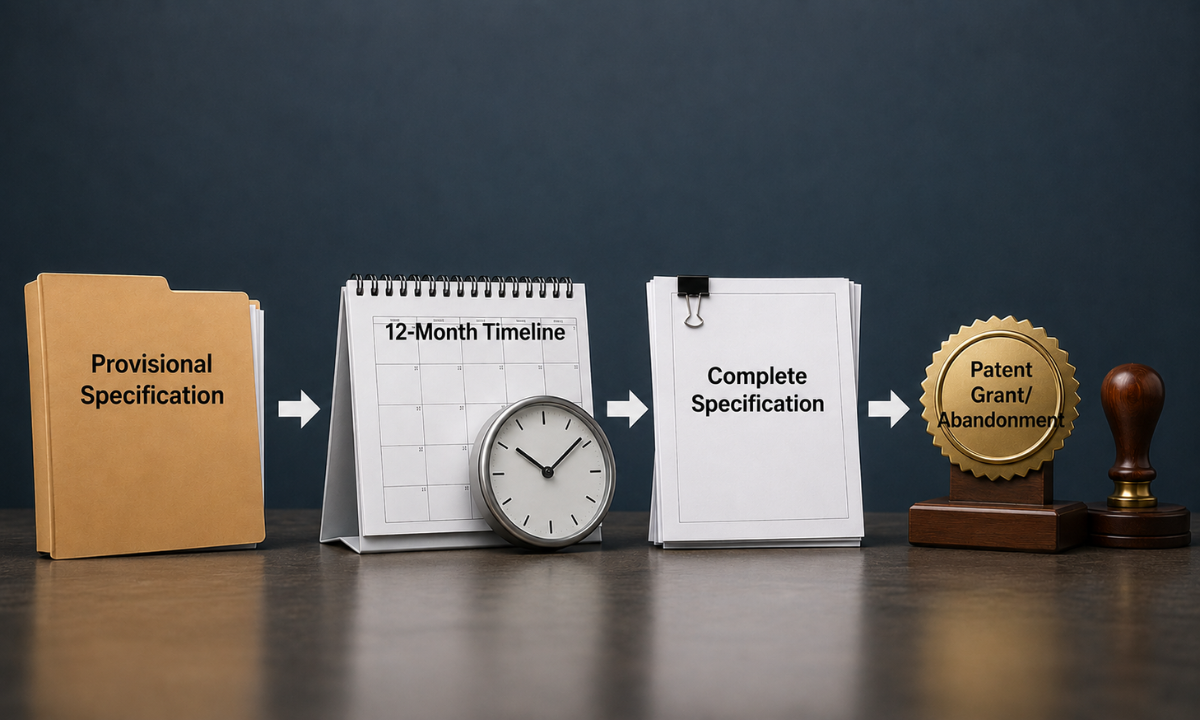
Understanding what a provisional patent is requires analyzing the core legislative framework governing preliminary intellectual property disclosures in India. Under Chapter III, Section 9 of the Patents Act, 1970, a provisional specification is a formal legal document filed alongside an initial patent application when an invention is still in its conceptual or developmental stage.
It acts as an interim disclosure that establishes a legal priority date on the official Patent Office register, reserving the applicant’s technological claim without requiring a final, exhaustive claim set at the time of submission.
The statutory scaffold under Section 9 enforces strict procedural parameters that dictate how preliminary filings mature into full patent rights:
1. The Mandatory 12-Month Maturity Window (Section 9(1)):
When a provisional description accompanies an application, the applicant must file a Complete Specification within a strict 12-month timeframe from the initial filing date.
If the complete specification is not filed within this non-extendable statutory period, the application is deemed irrevocably abandoned by operation of law.
2. Consolidation via Cognate Applications (Section 9(2)): Where an applicant files multiple preliminary specifications for inventions that are closely related, incremental modifications, or cognate in nature, Section 9(2) empowers the Controller to allow the consolidation of these separate filings into a single Complete Specification.
In such cases, the priority date for each feature corresponds to the filing date of the provisional disclosure that first introduced it.
3. Conversion Mechanisms (Section 9(3)): If an applicant initially submits an application accompanied by a complete specification but realizes that the technical disclosure requires further refinement or expansion, they may request the Controller within 12 months to treat the complete specification as a provisional specification, restarting the development timeline.
Statutory Consequences of Abandonment: The 12-month complete filing rule under Section 9(1) is a zero-tolerance statutory boundary. Unlike procedural defaults that allow petition-based condonation of delay, failing to file the Complete Specification within 12 months results in absolute statutory abandonment, causing the invention to lose its priority date permanently.
Ultimately, Section 9 provides a balanced statutory framework designed to encourage early technical disclosure while ensuring public access to finalized patent documents.
Understanding the legal interactions between provisional priority dates, cognate application rules, and abandonment consequences, inventors can structure their R&D and patent prosecution strategies with total compliance.
Strategic Commercial & Technical Advantages
Opting for an early provisional patent filing offers inventors, technology startups, and corporate R&D divisions significant strategic leverage beyond simple administrative convenience.
By locking in an official filing date while deferring the complex drafting of formal claims, applicants can align their intellectual property protection directly with commercial and technical validation milestones.
Primary Strategic Benefits for Innovators and Enterprises
- Securing Immediate First-to-File Priority: As Indian patent law follows a strict “first-to-file” system, establishing an early legal timestamp prevents competitors from claiming priority over identical or similar technologies developed independently at a later date.
- The “Patent Pending” Commercial Leverage: Once the application acknowledgement is issued by the Patent Office, the applicant obtains the legal right to mark their product, marketing materials, or prototype documentation as “Patent Pending” or “Patent Applied For”. This signals technical novelty to prospective licensees, enterprise clients, and investors during funding rounds.
- 12-Month R&D and Market Validation Buffer: The statutory 12-month window between the preliminary disclosure and the mandatory complete application provides valuable time. R&D teams can refine product design parameters, perform clinical trials, or test commercial viability before committing substantial capital to full patent prosecution.
- Capital Efficiency & Cost Deferral: Preparing a preliminary technical disclosure requires significantly lower upfront professional investment compared to drafting a full claim set. This allows early-stage companies to conserve initial capital while maintaining absolute priority rights.
- Foundation for Global Patent Expansion: The priority date secured in India serves as the baseline priority claim for international filings under the Paris Convention or the Patent Cooperation Treaty (PCT). As long as overseas applications are submitted within 12 months, the Indian priority date is recognized across global jurisdictions.
Commercial Disclosure Safety: Publicly demonstrating an invention at trade shows or pitching to prospective investors before securing a priority date can permanently destroy the novelty requirement needed for patentability. Filing a preliminary specification ensures that discussions conducted during the 12-month window do not compromise the validity of the future patent.
Ultimately, utilizing this preliminary filing pathway acts as an indispensable business tool that bridges early technical conceptualization with formal legal monetization. It provides innovators with the freedom to publicly disclose, pitch, and refine their technology without risking the loss of their core intellectual property assets.
Step-by-Step E-Filing Process & Mandatory Forms

Executing a provisional patent in India requires navigating the official e-filing portal of the Controller General of Patents, Designs and Trade Marks (CGPDTM) at ipindia.gov.in. To ensure that an application receives an immediate priority stamp and meets all statutory filing standards, applicants must submit a structured dossier of prescribed statutory forms alongside the preliminary technical specification.
Operational Step-by-Step Filing Workflow
- Prior Art & Freedom-to-Operate Search: Conduct a preliminary search across the Indian Patent Advanced Search System (InPASS) and international databases (such as WIPO Patentscope) to confirm that the conceptual framework possesses baseline novelty before initiating formal documentation.
- Drafting Form 2 (Provisional Specification): Prepare the technical narrative outlining the title, technical field, background, and enabling description of the invention. At this stage, no formal patent claims are included.
- Preparing Statutory Administrative Forms:
- Form 1 (Application for Grant of Patent): The primary administrative petition containing applicant details, inventor names, category of applicant, and title of the invention.
- b. Form 5 (Declaration as to Inventorship): Identifies the true and first natural persons who contributed inventively to the technology.
- Form 28 (Concessional Fee Eligibility): Submitted by natural persons, DPIIT-recognized startups, MSMEs, or educational institutions to claim statutory fee concessions.
- Form 26 (Power of Attorney): Executed when an authorized patent agent or law firm represents the applicant.
- Portal Upload & Digital Signature Execution: Upload the compiled PDF files to the IP India e-filing gateway, authenticating the submission using a Class 3 Digital Signature Certificate (DSC).
- Fee Payment & Priority Receipt Generation: Complete the statutory fee payment online to instantly generate the official Filing Receipt containing the unique Application Number and timestamped priority date.
Statutory Fee Structure (CGPDTM Portal)
| Applicant Category | E-Filing Statutory Fee (Up to 30 Pages) | Physical Submission Fee |
|---|---|---|
| Natural Person / Individual Inventor | ₹1,600 | ₹1,760 |
| DPIIT-Recognized Startup | ₹1,600 | ₹1,760 |
| Small Entity (MSME) / Educational Institution | ₹1,600 | ₹1,760 |
| Large Entity / Corporate Body | ₹8,000 | ₹8,800 |
Filing electronically not only avoids the 10% statutory surcharge levied on physical paper submissions but also provides instant generation of the CBR (Cash Receipt) and application number. By securing an automated electronic filing receipt, applicants establish an unalterable priority timestamp that serves as the legal foundation for all subsequent complete specification filings, PCT international expansions, and commercial licensing negotiations over the next 12 months.
Comparative Anatomy: Provisional vs. Complete Specification
While both documents are submitted using Form 2 under the Patents Rules, 2003, their structural requirements, legal functions, and technical scopes differ significantly.
Understanding these distinctions is critical when preparing a provisional specification patent filing, as omitting key technical principles at the preliminary stage can restrict the scope of claims you can legally assert in the subsequent complete application.
The comparative matrix below details the structural and legal differences between Form 2 preliminary disclosures and final complete applications:
| Document Feature | Provisional Specification (Form 2) | Complete Specification (Form 2) |
|---|---|---|
| Primary Statutory Goal | Establishes an early priority date and discloses the broad inventive concept. | Defines the exact legal monopoly boundaries and technical best mode of working. |
| Patent Claims Set | Not required. Claims are omitted to allow the technical concept to evolve during development. | Mandatory. Defines the precise legal boundary of protection and enforcement rights. |
| Abstract & Summary | Optional. Focuses on descriptive enablement rather than public summaries. | Mandatory. Requires a concise technical abstract (under 150 words) for public disclosure. |
| Best Mode Disclosure | Describes the general working parameters known at the time of filing. | Mandatory. Must disclose the absolute best mode of performing the invention known to the applicant. |
| Legal Validity Period | Temporary statutory instrument (expires after 12 months if not linked to a complete filing). | Permanent legal document governing the 20-year term of the granted patent. |
While a preliminary disclosure does not require formal claims, the technical description must still meet the legal standard of “enablement”. This means the written description must contain sufficient technical detail to enable a person skilled in the art to understand and reproduce the core inventive concept.
Any inventive feature added later in the complete specification that was not adequately supported in the initial provisional disclosure will not receive the benefit of the earlier priority date, exposing that specific feature to intervening prior art risks.
Why Choose Escalade Legal Services?
Navigating intellectual property protection requires experienced counsel who can translate complex technical concepts into robust, enforceable patent assets.
Operating from our centralized corporate practice in Bengaluru, we provide comprehensive IP strategy and patent prosecution services for technology startups, research institutions, and enterprise R&D hubs.
When innovators and growing businesses partner with our IP desk, they gain distinct operational advantages:
- Precision Techno-Legal Drafting: Our specialized team of Patent Lawyers in Bangalore works directly alongside your engineering and technical teams to capture core inventive concepts with maximum scope and full enablement under Indian and international patent laws.
- Forensic Prior Art & Novelty Analysis: We perform exhaustive preliminary searches across global databases to ensure your provisional disclosure establishes a clean, defensible foundation before formal submission.
- End-to-End Portfolio Management: From initial provisional filings on the CGPDTM portal to PCT international applications and national phase entries, we manage your complete patent lifecycle with strict statutory timeline enforcement.
Partnering with Escalade Legal Services, you ensure that your early-stage technical breakthroughs are backed by a robust legal strategy. We help you secure early priority dates, manage statutory deadlines, and build commercialized IP assets with complete operational confidence.
Conclusion
Filing a provisional patent specification is one of the most effective strategic moves an inventor or enterprise can make in India’s first-to-file patent ecosystem. By locking in an early priority timestamp while reserving a 12-month window for technical refinement, prototype testing, and commercial validation, innovators establish a strong position against competitors while optimizing initial capital expenditure. Act swiftly to anchor your technological breakthroughs before public disclosure or competing filings compromise your statutory rights.