
Have you created something new and are now wondering how to protect it legally in India? If yes, the next logical step is to file for a patent and secure exclusive rights over your invention.
Filing a patent may sound complicated at first, but once we understand the steps, documents, timelines, and costs involved, the process becomes much clearer.
In India, securing legal protection through proper patent registration in India helps us prevent others from copying, manufacturing, or selling our invention without permission.
Whether you are a startup, an individual, or an established company, filing a patent is one of the smartest business decisions you can make.
In this detailed guide, we will walk step-by-step through the patent application process in India, required documents, government fees, professional charges, and everything else you need to know before applying.
By the end of this blog, you will confidently understand how to protect your innovation and avoid costly mistakes in the process.
Disclaimer
The information shared in this blog is for general informational purposes only and does not constitute legal advice. Patent laws, procedures, timelines, and patent filing costs in India may change over time and can vary based on individual circumstances. Before you file for a patent or proceed with patent registration in India, we recommend consulting a qualified legal professional for advice specific to your situation.
Key Points At A Glance
- Filing a patent gives exclusive legal rights for 20 years.
- The patent application process in India involves drafting, filing, publication, examination, and grant.
- Government fees for online filing start at ₹1,600 for individuals/startups.
- Patent filing cost in India varies based on entity type and complexity.
- Professional drafting charges range between ₹12,000 and ₹75,000.
- Patent E Filing reduces costs and speeds up processing.
- Tracking patent application status in India is possible online.
- Proper documentation increases the chances of a patent grant.
- Understanding the patent grant procedure avoids delays.
- A patent grant certificate confirms legal ownership.
What Does It Mean To File for a Patent?
When we file for a patent, we formally apply to the Indian Patent Office, requesting exclusive rights over our invention. This gives us legal authority to stop others from copying or commercially using our innovation.
A patent is valid for 20 years from the filing date. However, it must meet three important criteria:
- Novelty (new invention)
- Inventive step (not obvious)
- Industrial applicability
If these conditions are satisfied, the Patent Grant can be obtained.
Understanding The Patent Application Process in India

The patent application process in India follows a structured legal framework under the Patents Act, 1970. Let us break it down into simple steps.
Step 1: Patent Check India (Prior Art Search)
Before filing, we must conduct a patent check in India to ensure our invention is new. This step helps us avoid rejection.
We can:
- Search on the Indian Patent Office database
- Use international patent databases
- Consult an attorney for a patent for a professional search
Skipping this step can result in wasted money and time.
Step 2: Drafting The Patent Application
This is the most critical step. The application must include:
| Document | Purpose |
|---|---|
| Title of Invention | Short description |
| Abstract | Summary of the invention |
| Detailed Description | Technical explanation |
| Claims | Legal scope of protection |
| Drawings | Visual explanation (if required) |
| Form 1 | Application form |
| Form 2 | Provisional/Complete specification |
| Form 3 | Foreign filing details (if any) |
| Form 5 | Declaration of inventorship |
Proper drafting ensures stronger protection. Many applicants hire an attorney for a patent because poor drafting can weaken rights.
Step 3: Patent E-Filing
Today, most applications are submitted through patent E-filing. Online filing reduces errors and offers lower government fees compared to physical filing.
Advantages of patent E-filing:
- Lower fees
- Faster submission
- Online document tracking
- Digital acknowledgement
Step 4: Publication Of Application
The application is automatically published 18 months after the filing date. We can request early publication for faster processing.
After publication, the invention becomes publicly visible, but rights are enforceable only after a patent grant.
Step 5: Request For Examination
Filing alone is not enough. We must file a request for examination within 48 months.
| Examination Type | Fee (Individuals/Startups) | Fee (Large Entities) |
|---|---|---|
| Regular Examination | ₹4,000 | ₹20,000 |
| Expedited Examination | ₹8,000 | Up to ₹60,000 |
The examiner reviews novelty, inventive step, and patentability.
Step 6: Responding To Examination Report
The Patent Office may issue objections in a First Examination Report (FER). We must respond within the specified time.
Professional charges for responding to examination reports range from:
₹10,000 to ₹35,000.
Timely response increases chances of patent grant.
Step 7: Patent Grant Procedure
Once objections are resolved, the patent grant procedure is completed. The Patent Office officially grants the patent.
The applicant then receives a patent grant certificate, which serves as proof of ownership.
Documents Required To File for a Patent
Here is a simple checklist:
| Document | Required? |
|---|---|
| Identity proof of the applicant | Yes |
| Address proof | Yes |
| Invention details | Yes |
| Drawings | If applicable |
| Power of Attorney | If filing through an agent |
| Startup recognition certificate | If applicable |
Keeping documents ready avoids delays.
Patent Filing Cost In India – Detailed Breakdown
Understanding patent filing cost in India helps us plan financially.
1. Government Fees (E-Filing)
| Component | Individuals/Startups | Large Entities |
|---|---|---|
| Filing (up to 30 pages, 10 claims) | ₹1,600 | ₹8,000 |
| Extra Claim | ₹320 per claim | ₹320 per claim |
| Extra Page | ₹160 per page | ₹160 per page |
| Request for Examination | ₹4,000 | ₹20,000 |
| Expedited Examination | ₹8,000 | Up to ₹60,000 |
2. Professional Fees
| Service | Approximate Cost |
|---|---|
| Drafting & Filing | ₹12,000 – ₹75,000 |
| Responding to FER | ₹10,000 – ₹35,000 |
3. Overall Estimated Cost
- For individuals/startups: ₹20,000 – ₹50,000 (simple patent)
- For complex or corporate filings: ₹100,000 or more
The final patent filing cost in India depends on the invention complexity, the number of claims, and professional assistance.
How To Track Patent Application Status in India
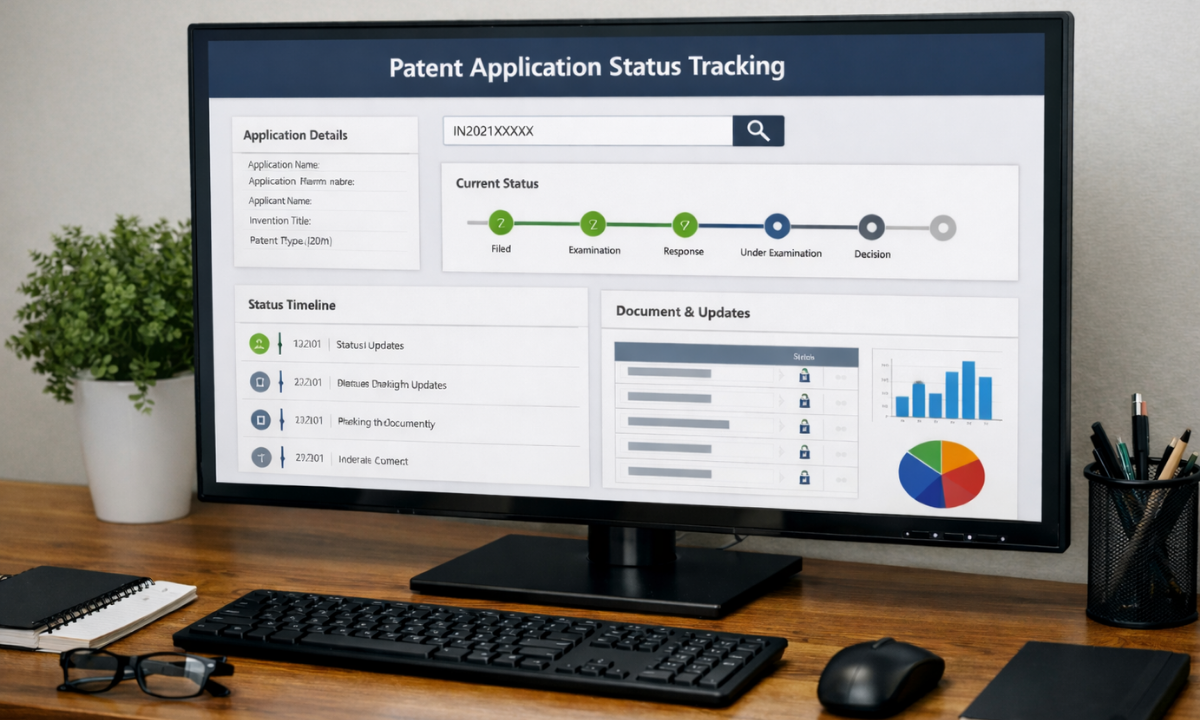
After filing, we can check the patent application status in India online through the Indian Patent Office website.
We need:
- Application number
- Filing date
Tracking status helps us stay updated on examinations and objections.
Timeline For Patent Grant
| Stage | Approximate Time |
|---|---|
| Filing | Day 1 |
| Publication | 18 months |
| Examination | 1–3 years |
| Patent Grant | 2–5 years total |
Expedited examination reduces time significantly.
Benefits Of Filing a Patent Early

When we file for a patent early, we:
- Secure priority date
- Block competitors
- Increase investor trust
- Improve valuation
Startups especially benefit from early filing.
Common Mistakes To Avoid
- Not conducting a patent check in India
- Poor claim drafting
- Missing examination deadline
- Ignoring objections
- Underestimating patent filing cost in India
Avoiding these mistakes increases the success rate.
Final Thoughts
Choosing to file for a patent is not just a legal formality; it is a strategic business decision. From understanding the patent application process in India to calculating patent filing cost in India, every step must be handled carefully.
A successful patent grant strengthens your market position and protects years of hard work. Proper patent registration in India ensures that your invention remains legally secure and commercially valuable for 20 years.
If you are planning to protect your innovation, seeking expert guidance can make the journey smoother and more effective. With professional support from Escalade Legal Services, you can confidently navigate the patent process and secure strong legal protection for your ideas.
FAQs
1. How long does it take to get a Patent Grant?
Getting a Patent Grant in India typically takes between 2 and 5 years from the filing date. The timeline depends on factors such as when the request for examination is filed, the workload of the Patent Office, and whether objections are raised in the examination report.
If objections are minimal and responses are filed promptly, the process may move faster. Startups and eligible applicants can also opt for expedited examination to reduce the overall time.
2. What is the cheapest way to File For Patent?
The most cost-effective way to File For Patent in India is by using Patent E-Filing, as online filing offers lower government fees compared to physical submission.
Individuals, startups, and small entities benefit from significantly reduced official charges. Additionally, keeping the application within 30 pages and limiting claims to 10 helps avoid extra fees. Proper drafting at the initial stage can also prevent costly objections later.
3. Can startups get fee benefits?
Yes, startups registered under the Government of India recognition system are eligible for concessional patent filing fees. They pay much lower government charges compared to large entities for filing, examination, and even expedited examination. This financial support encourages innovation and makes patent protection more accessible to emerging businesses. However, proper documentation proving startup status must be submitted to claim these benefits.
4. What is a Patent Grant Certificate?
A Patent Grant Certificate is the official legal document issued by the Indian Patent Office after the successful completion of the Patent Grant Procedure. It confirms that the invention has met all legal requirements and is now protected under Indian patent law.
This certificate serves as proof of ownership and grants the patent holder exclusive rights to make, use, sell, or license the invention for 20 years.
5. Is hiring an Attorney For Patent necessary?
Hiring an Attorney For Patent is not legally mandatory, but it is highly recommended, especially for complex inventions.
Patent drafting requires technical precision and legal expertise, particularly while preparing claims that define the scope of protection. A qualified attorney can also handle objections, respond to examination reports, and ensure compliance with deadlines. Professional guidance significantly improves the chances of approval and reduces the risk of rejection.
Reference:
1. From Google
2. https://registrationguru.in/blog-view/how-much-does-patent-registration-cost