
As organizations expand their digital infrastructure, securing expert DPDP Act Compliance Services in India has become as essential as deploying robust technical defenses. Today’s threat landscape is defined by synthetic identity theft, deepfake financial extortion, cloud ransomware, and automated data exfiltration.
Navigating this environment requires a precise understanding of the law for cyber crime in India, transforming cyber legal awareness from a reactive emergency measure into a vital strategic asset for business leaders, board members, and private citizens alike.
The legal framework governing digital offenses in India has undergone a fundamental shift. The convergence of modernized criminal codes, strict 6-hour incident reporting directives from CERT-In, and heavy financial penalties for data privacy breaches under the Digital Personal Data Protection framework has created an unprecedented level of regulatory scrutiny.
A single unaddressed security vulnerability or delayed breach notification can instantly trigger multi-crore regulatory fines, civil liability claims, and criminal prosecution.
The Regulatory Imperative: Under current Indian cyber jurisprudence, ignorance of statutory compliance protocols offers zero protection against corporate liability or financial loss. When an enterprise or individual suffers a digital attack, immediate legal containment ranging from emergency bank account freezes to statutory evidence preservation is the only way to minimize reputational damage and secure legal remedies.
Whether you are an enterprise officer managing a corporate breach, a startup founder building data handling architecture, or an individual recovering from an online financial scam, understanding your statutory rights and duties is critical.
This comprehensive guide breaks down the core statutory frameworks, emergency reporting mechanisms, and formal investigation procedures required to protect your digital assets and enforce your legal remedies.
Legal Disclaimer
The statutory interpretations, procedural roadmaps, and regulatory insights detailed in this guide are provided strictly for educational and general informational context. This material does not constitute formal legal advice, a binding legal opinion, or an active attorney-client relationship with Escalade Legal Services. As cyber crime regulations, state-specific police procedures, and data protection enforcement guidelines undergo continuous updates, you must secure dedicated legal counsel and a case-specific strategy from a certified cyber attorney before executing formal legal filings or corporate incident response actions.
Statutory Pillars for The Interlocking Cyber Regulatory Framework
Combating digital offenses in 2026 requires navigating an integrated legal framework that bridges specialized cyber statutes, modernized general criminal codes, and strict administrative guidelines.
In India, cyber offenses are not governed by a single isolated piece of legislation; rather, they are prosecuted through a dual civil and criminal system designed to address both individual victimization and enterprise-level systemic breaches. Understanding how these statutory regimes overlap is critical for establishing legal liability, enforcing corporate accountability, and mounting an effective defense.
Together with specialized regulatory directives, these statutory codes form the core matrix of cyber crime laws in India, providing law enforcement and judicial bodies with dual civil-criminal enforcement powers.
Key Statutory Vectors Governing Cyber Offenses
The legal architecture addressing digital misdeeds in India operates primarily across three distinct statutory pillars:
- The Primary Legislative Anchor: Enacted as the bedrock legislation for electronic commerce and digital governance, the Information Technology Act, 2000 defines both civil contraventions and penal cyber offenses.
- Modernized Criminal Prosecution (BNS, 2023): The Bharatiya Nyaya Sanhita (BNS), 2023 works alongside specialized tech statutes to penalize cyber-enabled conventional crimes. It provides severe penalties for digital forgery, impersonation fraud, extortion via ransomware, and organized online syndicates.
- Mandatory Incident Reporting (CERT-In Directives): Managed under Section 70B of the IT Act, the Indian Computer Emergency Response Team (CERT-In) enforces strict cybersecurity guidelines. These rules mandate that all corporate entities, cloud service providers, and data fiduciaries report defined cyber incidents within a mandatory six-hour window of detection.
Core Penal Provisions under the IT Framework
To understand the legal exposure of a cyber incident, corporate boards and individuals must evaluate the specific statutory charges applicable under the primary tech act:
| Statutory Provision | Offense & Technical Scope | Legal Consequence & Exposure |
|---|---|---|
| Section 43 | Civil liability for unauthorized access, data extraction, malware deployment, or system disruption. | Adjudicated civil compensation to affected parties without a statutory upper limit. |
| Section 66 | Hacking and dishonest or fraudulent computer system manipulation. | Imprisonment up to 3 years and/or fines up to ₹5 Lakh. |
| Section 66C & 66D | Identity theft, credential harvesting, and cheating by impersonation using digital resources. | Cognizable and non-bailable imprisonment up to 3 years plus statutory fines. |
| Section 66E | Violation of privacy through unauthorized capturing, publishing, or transmitting intimate images. | Imprisonment up to 3 years and/or statutory monetary fines. |
| Section 66F | Cyber terrorism targeting critical national information infrastructure or threatening state security. | Severe non-bailable offense punishable by life imprisonment. |
Navigating these overlapping statutory frameworks requires legal counsel to immediately categorize the precise nature of an incident upon discovery.
As a single ransomware attack or corporate data breach can simultaneously trigger civil compensation claims under Section 43, criminal prosecution under Section 66, and regulatory enforcement for non-reporting, establishing immediate legal privilege and forensic oversight is paramount. Proper statutory alignment ensures that a victimized organization preserves its rights to claim damages while maintaining full compliance with state authorities.
Legal Remedies and Recourse Against Digital Financial Offenses
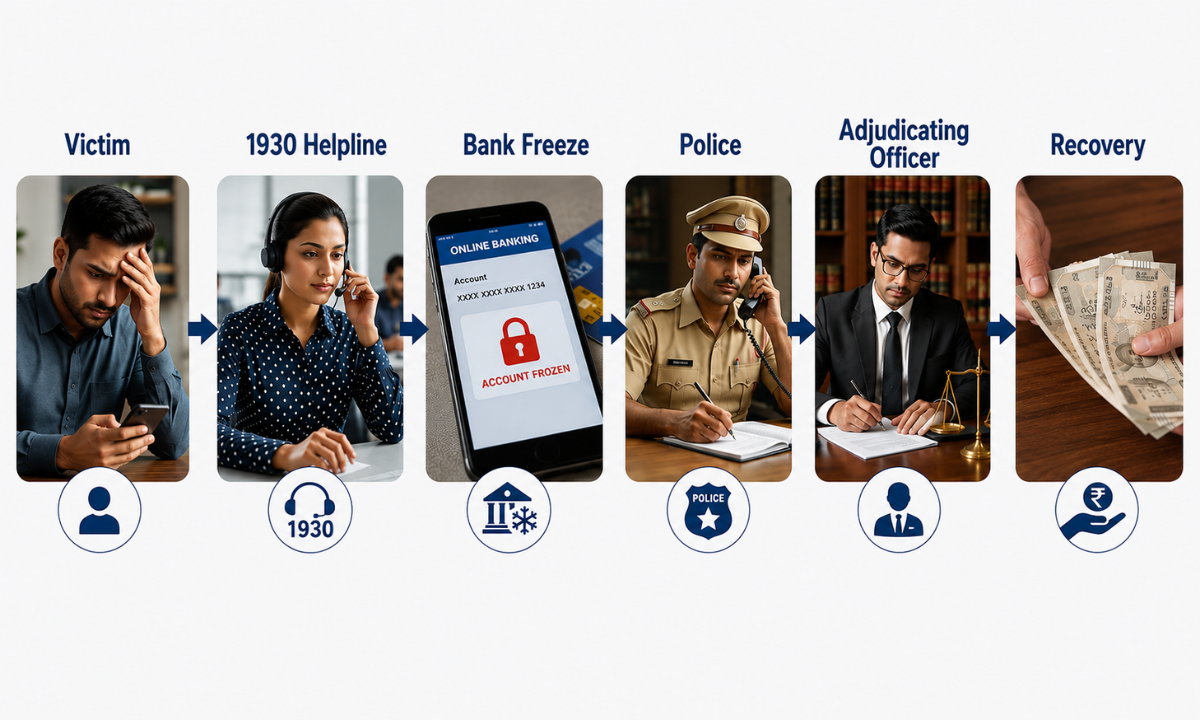
When an enterprise or individual falls victim to unauthorized electronic fund transfers, UPI drain scams, or corporate ransomware extortion, immediate legal and procedural intervention is critical. Financial cyber offenses involve rapid capital movement through networks of automated “mule” accounts.
Securing effective legal action against online fraud in India requires victims to simultaneously leverage statutory civil recovery mechanisms, emergency banking freeze protocols, and regulatory loss-limitation frameworks.
Victims of online financial fraud have distinct legal pathways to recover diverted funds, hold financial intermediaries accountable, and seek civil compensation:
Key Legal Avenues for Financial Cyber Recovery
Civil Compensation via the Adjudicating Officer (Section 46, IT Act):
For losses resulting from unauthorized system access, data theft, or identity impersonation, victims can file a petition before the state’s Adjudicating Officer (appointed under Section 46 of the IT Act).
The Adjudicating Officer holds quasi-judicial powers equivalent to a civil court and can award damages up to ₹5 crore per claim. Appeals against these orders are heard by the Telecom Disputes Settlement and Appellate Tribunal (TDSAT).
RBI Limited Liability Protection:
Under Reserve Bank of India (RBI) mandates governing unauthorized electronic banking transactions, individual account holders enjoy zero liability if an unauthorized transaction occurs due to bank negligence or third-party system compromise; it is reported to the bank within three days of occurrence.
If reported within four to seven days, the customer’s liability is strictly capped based on account type, shifting the primary financial risk back to the banking institution.
Emergency Account Liens and Debit Freezes:
Through the Citizen Financial Cyber Fraud Reporting and Management System (CFCFRMS) integrated with helpline 1930, law enforcement officers can issue immediate electronic “hold” directives to destination banks.
This prevents scammers from withdrawing or laundering fraudulently acquired funds before formal judicial orders are issued.
Strategic Framework: Civil vs. Criminal Financial Remedies
| Recovery Vector | Primary Statutory / Regulatory Basis | Pecuniary Scope & Jurisdiction | Primary Operational Objective |
|---|---|---|---|
| Statutory Adjudication | Section 46 & Section 43, Information Technology Act | Claims up to ₹5 Crore (State AO); Above ₹5 Crore (Civil Courts) | Direct compensation from negligent parties or perpetrators. |
| Banking Ombudsman Escalation | RBI Ombudsman Scheme / Consumer Protection Act | Reversal of unauthorized debits; compensation up to ₹20 Lakhs | Reimbursing losses caused by deficiency in banking service or security failure. |
| Criminal Account Freezing | Section 106, Bharatiya Nagarik Suraksha Sanhita (BNSS), 2023 | Unlimited (Covers all identified beneficiary accounts) | Securing assets for post-trial restitution or court-ordered refund. |
Successfully securing financial recovery requires acting within the critical initial hours following an unauthorized transaction. If a victim delays reporting or fails to properly preserve electronic transaction IDs, digital logs, and communication threads, the likelihood of recovering stolen capital diminishes rapidly as funds are laundered across multiple accounts or converted into untraceable assets.
Working alongside specialized legal counsel ensures that emergency bank notifications, statutory compensation claims before the Adjudicating Officer, and police freeze petitions are executed concurrently to preserve lost capital.
Emergency Reporting Roadmap: Helplines, Portals, and First Responders

When responding to a digital breach or online fraud, speed is the single most critical factor determining whether stolen funds are recovered or digital evidence is preserved. Establishing a structured response protocol ensures that victims, whether individual account holders or corporate IT security teams, take immediate statutory action within the initial “golden hour” of incident detection.
Understanding how to report cyber crime in India requires navigating a multi-tiered reporting infrastructure managed by the Ministry of Home Affairs (MHA), the Indian Cyber Crime Coordination Centre (I4C), and national cybersecurity agencies.
Tier 1: Immediate Triage for Financial Frauds (The 1930 Mechanism)
- Dialing the National Helpline 1930: Victims of unauthorized bank debits, credit card scams, or UPI fraud must instantly contact the toll-free 1930 helpline.
- Providing Key Transaction Artifacts: The caller must furnish critical details, including the primary bank account number, the victim’s mobile number, payment gateway reference IDs, unique transaction reference (UTR) numbers, and exact timestamps of the unauthorized debits.
- Activating the CFCFRMS Intercept System: The 1930 operator logs the event on the Citizen Financial Cyber Fraud Reporting and Management System (CFCFRMS). This automatically transmits electronic freeze alerts to nodal officers at destination banks and wallets, placing a temporary lien on the defrauded funds before scammers can cash them out.
Tier 2: Formal Digital Filing on the National Portal
- Accessing the Official Portal: Victims must log onto the National Cyber Crime Reporting Portal (cybercrime.gov.in), the centralized state interface for recording digital offenses.
- Selecting the Correct Incident Category: The portal categorizes complaints into distinct modules, including Financial Fraud, Crimes Against Women or Children, Deepfake Abuse, and General Cyber Crimes.
- Submitting Corroborative Evidence: Complainants must upload digital evidence files (under 5 MB), such as bank account statements, unedited SMS screenshots, email headers, chat logs, or suspicious website URLs.
- Generating the Unique Acknowledgement: Upon successful submission, the system generates an official acknowledgement. The complaint is electronically routed to the jurisdictional Cyber Crime Police Station (CCPS) for preliminary enquiry or FIR conversion.
Tier 3: Mandatory Enterprise & Corporate Incident Escalation (CERT-In)
- 6-Hour Mandatory Breach Notification: Under Section 70B of the IT Act and CERT-In directions, corporate entities, system integrators, and data fiduciaries are legally required to report defined cybersecurity incidents (such as ransomware attacks, unauthorized database access, or critical infrastructure outages) to CERT-In within six hours of identification.
- Preserving Technical Forensic Artifacts: Enterprise security teams must secure volatile memory dumps, system audit logs, firewall traffic dumps, and network intrusion vectors before initiating system restoration.
- Submitting the Incident Reporting Template: Corporate legal counsel must file the formal incident report via CERT-In’s official portal or dedicated email channels, establishing an official record of corporate compliance and mitigating potential regulatory penalties under data privacy laws.
Executing this multi-channel reporting protocol transforms an isolated cyber attack into a formally tracked legal matter handled across state networks.
Coordinating rapid 1930 financial intercept calls, detailed submissions on the national portal, and mandatory CERT-In corporate disclosures, victims create an unbroken chain of statutory reporting.
This proactive response not only optimizes the chances of recovering stolen funds through bank lien markings but also ensures that enterprise entities remain fully compliant with national cybersecurity laws.
Procedural Escalation: Evidence Handling and Police Investigation
When a cyber attack escalates beyond initial administrative reporting into formal litigation, establishing technical evidence admissibility becomes the paramount objective. Digital artifacts such as server traffic logs, exported WhatsApp chat threads, cloud database backups, or email headers are inherently volatile and easily challenged in court if proper handling protocols are neglected.
Executing a formal cyber crime complaint procedure in India requires victims, enterprise IT managers, and legal teams to combine rigorous forensic evidence preservation with structured police investigation procedures.
Digital Evidence Handling & Section 63 BSA Compliance Checklist

Under the Bharatiya Sakshya Adhiniyam (BSA), 2023, electronic records are treated as documentary evidence, but their admissibility in judicial proceedings requires strict statutory compliance with Section 63.
To ensure your digital artifacts stand up under judicial examination, follow this mandatory evidence preservation checklist:
- Preserve Raw Volatile Data First: Immediately isolate compromised endpoints and extract volatile memory, active network connection logs, and system RAM dumps before rebooting or applying system patches.
- Create Bit-Stream Forensic Copies: Generate a sector-by-sector bit-stream disk image of compromised drives using hardware write-blockers to prevent any metadata alteration during examination.
- Calculate Cryptographic Hash Values: Generate SHA-256 or MD5 hash values for all extracted electronic files immediately upon capture. The cryptographic hash acts as a unique digital fingerprint proving the file remains untampered.
- Maintain an Unbroken Chain of Custody Log: Document every transfer of physical drives or digital files in a formal evidence ledger recording timestamps, exact extraction tools used, serial numbers, and custodian identity.
- Prepare the Mandatory Section 63(4) BSA Certificate: Draft the statutory certificate as prescribed under the Schedule to Section 63 BSA.
Ensure Part A is signed by the lawful system controller and Part B is verified by a certified digital forensics expert, explicitly embedding the generated hash values and device identification numbers.
Procedural Roadmap: From Police Filing to Court Restitution

Converting a digital evidence dossier into an enforceable criminal case involves three systematic procedural milestones:
- Filing a Zero FIR or CCPS Lodgment: If local police stations lack immediate technical infrastructure or territorial jurisdiction, complainants can file a “Zero FIR” under the Bharatiya Nagarik Suraksha Sanhita (BNSS), 2023 at any station. The docket is then formally transferred to the specialized Cyber Crime Police Station (CCPS).
- Activating Investigating Officer (IO) Statutory Powers: Under Section 66 of the IT Act and Section 106 of BNSS, 2023, the appointed IO possesses broad powers to issue production notices to intermediaries (Meta, Google, ISPs), seize compromised hardware, and mandate debit freezes on beneficiary bank accounts.
- Judicial Restitution Petitions: Once law enforcement identifies and freezes defrauded capital in intermediary accounts, legal counsel files a petition before the local Magistrate under Section 497/503 BNSS to secure formal judicial orders releasing the frozen funds back to the victim.
Flawless execution across these procedural steps determines whether a cyber complaint leads to successful asset recovery or gets dismissed on technicalities.
If internal staff inadvertently overwrite system logs or submit uncertified screenshots without cryptographic hash reports, defense counsel can challenge the admissibility of the material under Section 63 of the BSA.
Working alongside specialized legal teams ensures that forensic acquisition, police docket management, and judicial restitution petitions align with current statutory standards, providing your case with the structural integrity required in court.
Why Choose Escalade Legal Services?
Navigating India’s evolving cyber law landscape requires a partner who seamlessly bridges high-stakes courtroom litigation with deep technical understanding of enterprise IT architecture. At Escalade Legal Services, operating from our corporate practice desk in Bengaluru, we provide rapid-response cyber incident containment, forensic evidence preservation, and comprehensive data protection compliance for corporate entities, financial institutions, and private investors.
When organizations face critical security breaches, financial cyber fraud, or complex regulatory audits, our dedicated team delivers decisive operational advantages:
- Cross-Disciplinary Cyber Litigation Desk: Our litigators bring extensive experience representing clients before Cyber Crime Police Stations (CCPS), Adjudicating Officers, the High Court, and the Telecom Disputes Settlement and Appellate Tribunal (TDSAT), securing both criminal prosecution and civil financial restitution.
- End-to-End Privacy Compliance: We provide specialized DPDP Act legal services in Bangalore to assist enterprise data fiduciaries in structuring legally compliant consent mechanisms, managing data principal rights, conducting privacy impact assessments, and executing CERT-In breach notifications.
- 24/7 Incident Escalation & Asset Freezing: We maintain dedicated rapid-response protocols designed to immediately activate the 1930/CFCFRMS financial intercept framework, secure emergency bank account liens, and lock down volatile digital evidence in full compliance with modern forensic standards.
Entrusting your cyber risk management and data privacy architecture to our firm, you ensure that potential legal liabilities are systematically mitigated before they escalate into public regulatory crises. We transform statutory compliance into a resilient defense strategy, safeguarding your corporate assets and market reputation in an interconnected global economy.
Conclusion
The legal framework governing cyber crime in India has transformed from a passive legislative system into an aggressive, highly enforced regulatory regime. For enterprises and individuals alike, surviving a digital attack or data breach is no longer just a technical challenge, it is a critical legal test. By taking immediate action to preserve cryptographic evidence, executing mandatory 6-hour incident reports, and enforcing statutory rights before specialized adjudications, victims can successfully recover diverted capital and hold non-compliant entities accountable.
Treating cybersecurity and data privacy as fundamental legal priorities is the ultimate key to insulating your organization from catastrophic operational and financial risk.