
Scaling an enterprise in today’s hyper-competitive marketplace demands far more than a disruptive product and venture capital; it requires an impenetrable legal foundation.
Too many founders mistakenly view business and corporate law as a passive administrative burden rather than a strategic asset. In reality, a robust legal framework is the precise architecture that enables rapid, secure scaling.
Operating as a premier Corporate law firm in Bangalore, we consistently see that the most dominant companies do not wait for a crisis to seek counsel. They deploy elite Corporate lawyers to aggressively shield their executive boards from personal liability and proactively structure their equity for future funding rounds.
Furthermore, by integrating the expertise of a specialized IP law firm in Bangalore, these growing companies lock down their proprietary assets and codebases before entering the public market.
Treating legal compliance as an afterthought is the fastest route to a frozen bank account, deactivated director identification numbers, or a blocked acquisition deal. This guide deconstructs the non-negotiable legal essentials required to transform a vulnerable, growing company into a legally unassailable corporate powerhouse.
Legal Disclaimer
The structural analyses, statutory timelines, and corporate compliance frameworks detailed within this guide are intended solely for general educational and informational purposes. This content does not constitute formal legal counsel, and accessing or reviewing this material does not establish an attorney-client relationship with Escalade Legal Services. Because corporate laws, foreign direct investment limits, and SEBI regulations shift rapidly, you must secure customized legal counsel before initiating formal statutory filings or executing structural corporate modifications.
Key Points at a Glance
- The Dual Legal Framework: A growing company must master both internal Corporate Law (board structuring and MCA compliance) and external Commercial Law (vendor risk allocation and IP protection).
- The Ironclad Compliance Calendar: Mandatory board meetings, exact statutory filing dates (Form AOC-4 and MGT-7), and 3-year DIR-3 KYC compliance cycles must be rigorously managed to prevent rapid DIN deactivation and ROC strike-offs.
- Limitation of Liability (LoL) is Non-Negotiable: Executive boards must never sign enterprise vendor contracts without capping financial liability strictly to the contract’s inherent value.
- The IP Ownership Trap: An enterprise’s valuation crashes during funding due diligence if employment and vendor contracts fail to include explicit “Work for Hire” intellectual property assignment clauses.
- Equity as an Incentive Mechanism: New amendments to the Companies Act allow private companies to legally deploy advanced Restricted Stock Units (RSUs) and Stock Appreciation Rights (SARs) without undergoing the complex purchase mechanics of traditional ESOPs.
The Pillars of Corporate Law vs. Commercial Law
To navigate a rapid scaling phase safely, your executive board must understand that business jurisprudence is split into two distinct operational forces: Corporate Law and Commercial Law.
Think of your company as a high-performance aircraft. Corporate law is the internal engineering that dictates how the cockpit is structured, how the pilots (directors) share control with the owners (shareholders), and how the engine complies with aviation laws.
Commercial law, conversely, governs the external flight path and how the aircraft interacts with external elements like fuel suppliers (vendors), customers, and weather systems (market risks).
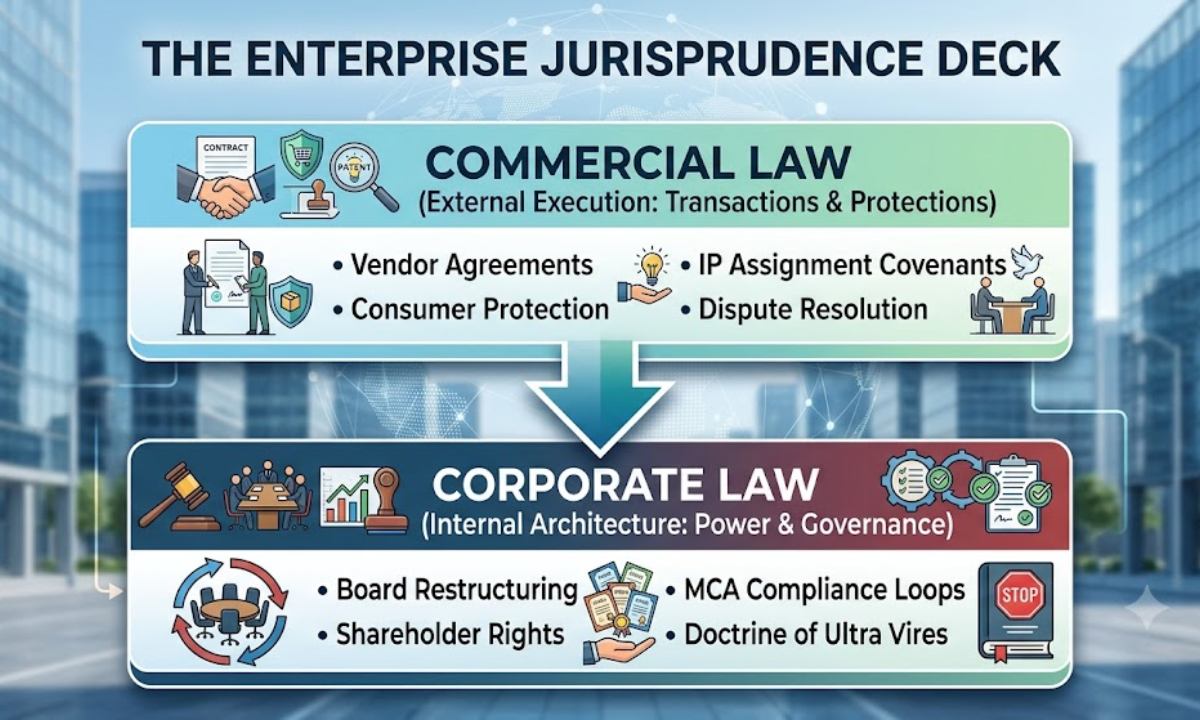
The Internal Engine: Corporate Architecture
Corporate law governs the birth, internal relationships, and statutory death of a legal entity. It is anchored firmly to the Companies Act, 2013, and focuses heavily on structural balance.
- Fiduciary Accountability: It sets the rules for how directors must act in the best interests of the company, eliminating conflicts of interest.
- The Doctrine of Ultra Vires: This structural rule establishes that a company cannot legally perform any action that falls outside the object clauses of its Memorandum of Association (MoA). Any contract signed outside these boundaries is automatically void, offering zero protection to the company.
Commercial Execution
Commercial law focuses entirely on the contracts, sales, and intellectual property protections that occur during daily market transactions. It is anchored to the Indian Contract Act, 1872, and the Sales of Goods Act, 1930.
- Risk Allocation: Commercial law ensures that when your sales team signs an enterprise deal, your liabilities are strictly capped via Indemnification and Limitation of Liability clauses.
- Asset Ring-Fencing: It establishes the legal mechanisms required to ensure that any software code, brand trademark, or proprietary algorithm developed by an employee or third-party vendor is legally owned by the corporate entity, not the individual.
The Structural Balance Sheet
An enterprise that ignores corporate law will face swift prosecution and structural shutdown by the Registrar of Companies (ROC). An enterprise that ignores commercial law will find itself drained of capital by predatory lawsuits and stolen intellectual property.
| Operational Realm | Primary Legislative Anchor | Core Focus Area | Failure Mode to Avoid |
|---|---|---|---|
| Corporate Law | The Companies Act, 2013 | Internal governance, board structuring, share allotments, and Ministry of Corporate Affairs (MCA) compliance. | ROC Strike-Off: Deactivation of director identities and loss of limited liability status due to filing failures. |
| Commercial Law | Indian Contract Act, 1872 | External B2B contracts, vendor liabilities, non-disclosure agreements, and IP assignment pipelines. | Capital Drain: Signing predatory vendor agreements that feature unlimited financial liabilities and weak IP protection. |
By mastering both pillars, your management team shifts the legal department from a passive expense unit into an active operational shield that aggressively builds enterprise value.
The Ironclad Corporate Compliance Calendar

A common failure mode for scaling startups is treating statutory corporate compliance as an end-of-year accounting exercise.
Under the Ministry of Corporate Affairs (MCA) V3 portal architecture, compliance is entirely automated, and penalties compound daily. Executive boards must transition from a reactive filing approach to a proactive compliance calendar.
Meeting these legal requirements for companies is not just about avoiding the Registrar of Companies (ROC) fines; it is about maintaining a clean legal status for the inevitable institutional due diligence process. Below is the baseline statutory calendar that every corporate entity must aggressively maintain.
The Mandatory Annual Pipeline
Under the Companies Act, 2013, missing these core deadlines triggers instant financial penalties and exposes the board to direct judicial scrutiny.
- The Board Meeting Mandate: A private limited company must hold a minimum of four board meetings every financial year, ensuring the maximum gap between two meetings does not exceed 120 days. These minutes must be rigorously documented to prove the legality of all corporate decisions.
- The Annual General Meeting (AGM): Shareholders must officially adopt the audited financial statements within six months from the end of the financial year (typically by September 30th).
- Form AOC-4 (Financial Statements): Must be filed with the MCA within exactly 30 days of the AGM. This form submits the company’s balance sheet, profit and loss account, and the auditor’s report to the public registry.
- Form MGT-7/7A (Annual Return): Must be filed within 60 days of the AGM. This document provides a comprehensive summary of the company’s shareholding structure, debt profile, and director changes.
- DIR-3 KYC: Every individual holding an active Director Identification Number (DIN) must verify their identity by September 30th. Failing this results in immediate DIN deactivation, legally paralyzing the director’s ability to sign any corporate document.
Trigger-Based and Threshold Audits
As your revenue and capital raise metrics grow, you trigger heavier compliance loads. Scaling companies must watch these critical thresholds:
- Statutory Audit: Required for every company regardless of turnover, but if your company breaches certain limits (e.g., turnover exceeding ₹200 Crores or outstanding bank loans exceeding ₹100 Crores), you must formally appoint an Internal Auditor to constantly monitor financial controls.
- Event-Based Filings: Corporate law demands real-time reporting. If you change your registered office, appoint a new director, or issue new shares to investors, forms like INC-22, DIR-12, and PAS-3 must be filed within 30 days of the event. Delaying these filings can legally invalidate the share allotment itself.
When your enterprise scales, this calendar is what separates a clean, investable corporate entity from one burdened by hidden liabilities and compounding MCA fines.
Business Risk Management: Contracts and IP Shielding

When venture capital firms or enterprise clients examine a growing company, they do not just look at revenue graphs; they hunt for unmitigated liabilities.
Business risk management is the process of using commercial law to build a contractual firewall around your enterprise. If your corporate framework is the engine, your contracts and intellectual property (IP) registrations are the armor plating.
Without an aggressive commercial contracting strategy, a single predatory vendor agreement or a leaked proprietary algorithm can instantly destroy millions of dollars in enterprise valuation.
1. The Contractual Firewall: Allocating Liability
Operating a business involves absorbing risk. The goal of commercial contracting under the Indian Contract Act, 1872, is to mathematically cap that risk and shift as much liability as possible away from your corporate entity.
When our attorneys audit growing companies, we consistently find critical weaknesses in three primary clauses:
- Limitation of Liability (LoL): Never sign an enterprise-level SaaS or service agreement without a hard financial cap on damages.
A properly drafted LoL clause ensures that, in the event of a software crash or delivery failure, your maximum financial exposure is limited to the contract value (e.g., the fees paid over the last 12 months), protecting the core assets of the company.
- Airtight Indemnification: If a third-party vendor commits data theft or violates labor laws while working under your brand, indemnity clauses legally force the vendor to pay for the resulting lawsuits and regulatory fines, keeping your balance sheet clean.
- Asymmetric Termination Rights: A scaling startup must maintain operational agility. Your master service agreements must include termination for convenience clauses, allowing you to cut ties with underperforming vendors without being held hostage by long-term lock-in periods.
2. IP Shielding: Securing Your Enterprise Valuation
For modern tech-enabled companies, your intellectual property, your codebase, brand identity, client lists, and proprietary algorithms are your valuation.
Relying solely on company registration laws without an aggressive IP strategy leaves your most valuable assets completely exposed to theft by competitors and departing employees.
With the recent Patents (Amendment) Rules, 2025/2026, the Indian IP enforcement landscape has shifted dramatically, introducing faster administrative adjudication pathways and stricter penalties for infringement. To survive, scaling companies must execute a two-tier IP defense:
- The Trademark & Patent Moat: Before launching a new product line, the brand name and logo must be secured under the Trade Marks Act, 1999. If you possess a unique technical process, early patent filing is mandatory.
Under the updated 2026 framework, failure to digitally document and enforce your rights leaves you vulnerable to fast-tracked administrative penalties initiated by competitors.
- The Work for Hire Assignment Trap: This is the single biggest failure point during VC due diligence. By default, the creator of a piece of software or design owns the copyright. A growing company must have explicit IP Assignment Agreements signed by every single employee, freelancer, and third-party developer.
If your employment contracts do not explicitly state that all IP created during working hours is the exclusive, permanent property of the company, the developer can legally hold your codebase hostage right before a funding round.
The Due Diligence Danger Matrix
When institutional investors initiate their audit, they will test your commercial armor. Here is exactly what destroys valuation during a funding round:
| The Commercial Liability | The VC Due Diligence Reality 3 | The Escalade Strategic Fix |
|---|---|---|
| Missing IP Assignment Clauses | Investors will halt the deal, fearing the original developers could sue the company for copyright infringement. | Execute airtight IP Assignment and Non-Disclosure Agreements (NDAs) for all staff and vendors on day one. |
| Uncapped Liability Contracts | VCs view unlimited liability as a poison pill that could wipe out their investment in a single lawsuit. | Aggressively negotiate Limitation of Liability caps to equal the contract’s annual value. |
| Unregistered Trademarks | Competitors can legally hijack your brand name, forcing a costly mid-scale rebranding effort. | Secure comprehensive Trademark registrations across all relevant operational classes before market launch. |
Effective business risk management means treating every contract and line of code as a critical financial asset that must be locked down, categorized, and legally shielded before the market ever sees it.
Equity Architecture and Shareholder Rights

The internal power dynamics of a growing company are entirely dictated by how its equity is structured. When a Corporate law firm in Bangalore engineers a cap table, the goal is to balance the aggressive incentive mechanisms required to attract top talent with the defensive barriers needed to prevent hostile internal takeovers.
Founders frequently make the fatal mistake of distributing raw equity based on verbal agreements, only to face massive legal deadlock when a co-founder abandons the project or an early investor attempts to block a subsequent funding round. Corporate law provides the structural tools to prevent this.
1. The Statutory Evolution of Employee Incentives
To retain elite talent without draining cash reserves, scaling startups must issue equity-linked compensation.
Historically, this was restricted to standard Employee Stock Ownership Plans (ESOPs). However, under the sweeping Corporate Laws (Amendment) Bill, 2026, the legal framework has been modernized.
The new amendments formally recognize Restricted Stock Units (RSUs) and Stock Appreciation Rights (SARs) within the Companies Act itself.
- The Strategic Advantage: This allows private companies to issue sophisticated compensation schemes previously reserved only for SEBI-regulated, publicly listed entities.
Unlike ESOPs, which require the employee to actually purchase the stock at an exercise price, RSUs and SARs can be structured to simply pay out the value of the stock’s appreciation, avoiding complex internal share transfers while still locking in critical executive talent.
2. The Founders’ Agreement and Vesting Schedules
Never issue fully vested shares to a co-founder on day one. If a co-founder walks away after six months holding 30% of the company, that dead equity will immediately kill any future venture capital investment.
- The Legal Mechanism: Shareholder rights must be tightly bound by a Founders’ Agreement utilizing a Reverse Vesting schedule.
Under this legal framework, the company retains the right to buy back unvested shares at a nominal value if a founder leaves before a predefined cliff period (typically four years).
3. Shareholder Agreements (SHA) vs. Articles of Association (AoA)
When you accept institutional capital, the investors will force you to sign a Shareholder Agreement (SHA). This document dictates exact shareholder rights, including anti-dilution protections, board seats, and exit mandates.
- The Corporate Trap: An SHA is a private commercial contract. If its terms conflict with your company’s public Articles of Association (AoA), Indian corporate law dictates that the AoA prevails.
- The Execution: Elite corporate lawyers ensure that the moment an SHA is signed, the company’s AoA is simultaneously amended and filed on the MCA portal to perfectly mirror the new investor rights. Failing to entrench these rights leaves the founders legally vulnerable to breach of contract lawsuits.
The Escalade Corporate Blueprint
To transition from a vulnerable startup to an investable corporate entity, your executive team must execute a systematic legal lockdown. We use this exact blueprint when auditing high-growth companies preparing for Series A funding.
Phase 1: Internal Structural Lockdown
- Cap Table Vesting: Implement reverse-vesting schedules for all co-founders to prevent dead equity scenarios.
- Compensation Modernization: Transition from informal equity promises to legally compliant ESOP, RSU, or SAR pools under the 2026 Companies Act amendments.
- AoA Entrenchment: Ensure your Articles of Association have been formally updated to reflect any signed Shareholder Agreements.
Phase 2: Commercial Armor
- IP Assignment Pipelines: Audit all employment contracts and vendor agreements to ensure mandatory, airtight Work for Hire IP assignment clauses are signed.
- Liability Capping: Review all Master Service Agreements (MSAs) to ensure the Limitation of Liability is strictly capped to the annual contract value.
- Trademark Moat: Secure all brand names, product logos, and proprietary taglines under the Trade Marks Act before aggressive market expansion.
Phase 3: Statutory MCA V3 Compliance
- The V3 Migration Check: Ensure all corporate data is accurately linked and active on the fully web-based MCA V3 portal (V2 is permanently decommissioned).
- Director KYC Update: Audit your board’s compliance. Note the massive 2026 regulatory shift: the MCA has replaced the annual DIR-3 KYC filing with a streamlined 3-year compliance cycle. Ensure all directors have completed their baseline verification to prevent sudden DIN deactivation.
- Financial & Governance Filings: Confirm the flawless, on-time filing of AOC-4 (Financials) and MGT-7 (Annual Return) to avoid compounding daily statutory penalties.
Why Choose Escalade Legal Services?
Choosing the correct legal entity and maintaining its structural integrity is a foundational decision that separates successful market leaders from stagnant ventures.
When you secure Escalade Legal Services as your corporate counsel, you gain access to a dedicated team of elite Corporate lawyers who provide four non-negotiable legal advantages:
- Airtight Governance Engineering: We transition your board from a reactive filing approach to a proactive compliance calendar, guaranteeing absolute adherence to the Ministry of Corporate Affairs (MCA) mandates and protecting your directors from personal liability.
- Venture-Backed Structuring: We architect your cap table, Founders’ Agreements, and equity structures (including RSUs and ESOPs) to perfectly match the stringent due diligence standards required by top-tier venture capital firms.
- Commercial Risk Mitigation: We aggressively draft and negotiate your B2B Master Service Agreements to enforce strict Limitations of Liability and airtight indemnification clauses, protecting your cash flow from predatory lawsuits.
- Complete IP Asset Shielding: Operating dually as a top-tier IP law firm in Bangalore, our legal architects ensure your codebase, trademarks, and algorithms are permanently ring-fenced through ironclad assignment pipelines and patent registrations before you initiate massive market expansions.
We at Escalade Legal Services do not simply process annual paperwork; we provide elite structural legal engineering. Under the direct leadership of Attorney Venkata Raghavan, our firm operates as the premier Corporate law firm in Bangalore, aligning your legal framework directly with your aggressive commercial goals.
Conclusion
The architectural foundation of your business entity is the ultimate blueprint of your commercial security. True scaling occurs only when your executive board masters the duality of commercial risk management and corporate compliance. Whether you are executing complex B2B vendor agreements or preparing your board for a massive venture capital due diligence audit, ignoring the stringent requirements of business and corporate law leaves your enterprise dangerously exposed.
Do not wait for a failed funding round, an automated MCA penalty, or an intellectual property theft to expose the cracks in your legal foundation. Take absolute control of your corporate future. We invite your executive team to schedule a comprehensive structural governance audit at our Escalade Legal office, located in Bangalore.
Let our specialized transactional attorneys engineer a secure, highly scalable legal framework that empowers your business to dominate the marketplace with unassailable authority.