Share buyback is a corporate mechanism through which a company purchases its own shares or specified securities from its shareholders. Companies may undertake a buyback to return surplus funds, restructure their share capital, consolidate ownership or manage their capital structure.
However, a share buyback in India involves more than simply purchasing shares from existing shareholders. Companies must comply with the Companies Act, 2013, applicable rules, and, in the case of listed companies, the SEBI framework governing buybacks. The process also involves corporate approvals, shareholder communication, regulatory filings and post-buyback compliance.
Businesses considering a buyback can benefit from professional legal guidance at the planning stage. Experienced corporate lawyers in Bangalore can help companies assess the applicable requirements, prepare the necessary documentation and structure the transaction in accordance with Indian corporate law.
What Is a Share Buyback?
A share buyback, also known as a share repurchase, occurs when a company purchases its own shares or specified securities from its existing shareholders.
Section 68 of the Companies Act, 2013 permits a company to buy back its own shares or specified securities subject to prescribed conditions. The buyback may generally be financed from the company’s free reserves, securities premium account or the proceeds of an earlier issue of shares or specified securities, subject to the restrictions prescribed by law.
The Companies Act also establishes requirements relating to the company’s Articles of Association, approval process, buyback limits, debt levels, fully paid-up securities and the interval between successive buybacks.
For listed companies, the transaction is additionally governed by the SEBI (Buy-Back of Securities) Regulations, 2018, as amended from time to time. SEBI’s current regulatory listing shows amendments to the buyback regulations in July 2026.
Therefore, the applicable legal requirements should be checked based on the company’s status and the date on which the buyback is proposed.
Why Do Companies Buy Back Their Shares?
A company may consider a share buyback for several corporate and financial reasons.
Returning Surplus Funds to Shareholders
A company with excess cash may use a buyback as one method of returning capital to eligible shareholders, subject to the applicable legal conditions.
Restructuring Share Capital
A buyback reduces the number of shares outstanding and can therefore change the company’s share capital and ownership structure.
Consolidating Ownership
Depending on which shareholders participate in the buyback, the transaction may alter the relative shareholding percentages of remaining shareholders.
Providing an Exit Opportunity
A buyback can provide eligible shareholders with an opportunity to sell their shares to the company under the prescribed mechanism.
Managing Capital Structure
Companies may also consider buybacks as part of broader capital management and corporate restructuring decisions.
The commercial reason for the buyback should be assessed alongside the company’s financial position and legal eligibility. A buyback should not proceed merely because the company has available funds. The Board must consider whether the proposed transaction complies with the applicable statutory conditions.
Which Laws Govern Share Buybacks in India?
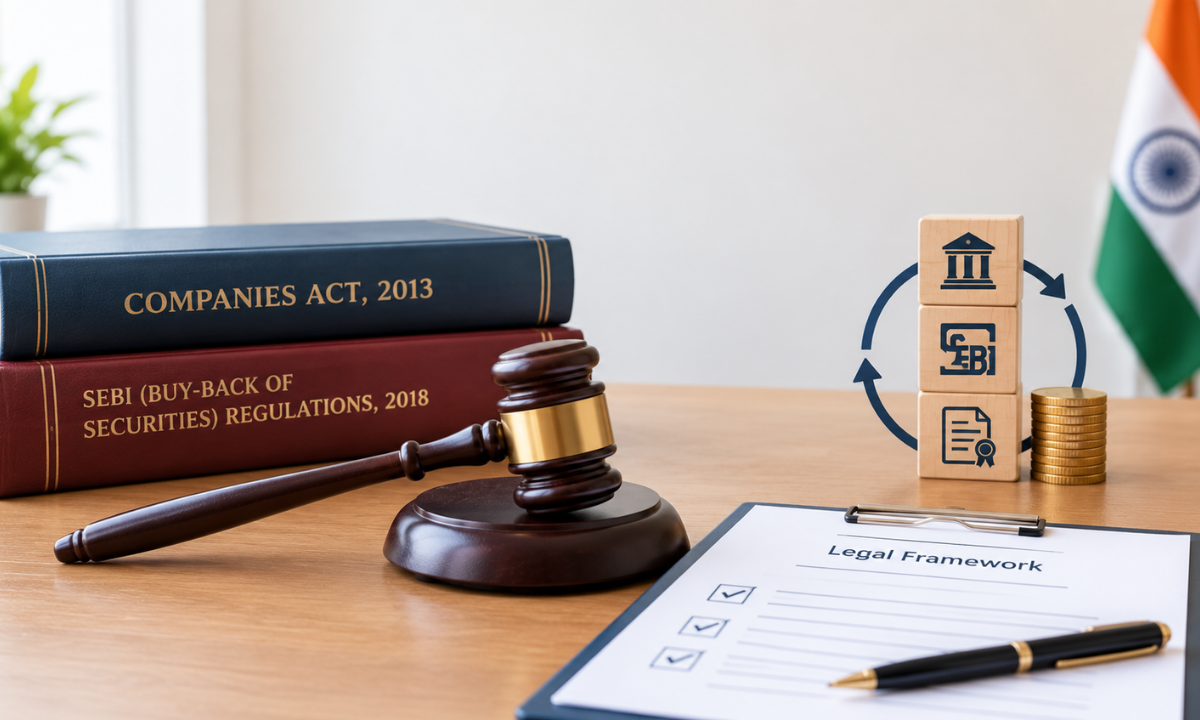
The legal framework applicable to a share buyback depends on whether the company is listed or unlisted and the nature of the securities involved.
Companies Act, 2013
Sections 68, 69 and 70 of the Companies Act contain important provisions concerning buyback, including the manner of financing, limits, restrictions and treatment of amounts following the buyback.
The Companies (Share Capital and Debentures) Rules, 2014 also prescribe requirements relevant to buyback transactions.
SEBI Buyback Regulations
Listed companies must also comply with the SEBI (Buy-Back of Securities) Regulations, 2018, together with applicable amendments and SEBI directions.
SEBI continues to maintain a dedicated buyback regulatory framework and buyback filing system covering transactions such as tender offers.
For example, SEBI filings from 2026 show listed companies implementing buybacks through the tender offer route and completing the associated public announcements, letters of offer and post-buyback disclosures.
Tax Laws
The tax treatment of a buyback also needs separate consideration. The applicable tax consequences depend on the date of the transaction and the status of the shareholder.
Because the tax framework has changed over time, companies should obtain transaction-specific tax advice rather than relying on an older buyback tax structure.
What Are the Eligibility Conditions for a Share Buyback?
Before approving a buyback, a company should verify whether it satisfies the applicable statutory conditions.
Some of the key requirements include the following.
Articles of Association Must Authorize the Buyback
The company’s Articles of Association must contain the necessary authority for the buyback.
If the Articles do not authorize the transaction, the company may need to amend them through the appropriate corporate procedure before proceeding.
Securities Must Be Fully Paid-Up
The shares or specified securities proposed to be bought back must be fully paid-up.
The company should verify its share capital records before determining the securities that will be included in the buyback.
Applicable Buyback Limit Must Be Observed
The Companies Act prescribes limits on the amount and proportion of securities that may be bought back.
The company should calculate the permitted amount using the relevant financial information and statutory provisions applicable to the transaction.
Debt Ratio Requirements Must Be Considered
The company must assess its debt position before and after the proposed buyback and ensure that the applicable statutory requirements are satisfied.
Previous Buyback Must Be Reviewed
The company should review whether it has conducted a previous buyback and whether the statutory restriction on a subsequent buyback affects the proposed transaction.
Outstanding Compliance Should Be Reviewed
Before proceeding, the company should also review its statutory records, financial statements, corporate approvals and other relevant compliance matters.
A preliminary legal review can help identify issues before the company commits to the transaction.
What Is the Maximum Share Buyback Limit in India?
Section 68 of the Companies Act generally restricts a company from buying back more than 25% of the aggregate of its paid-up capital and free reserves, subject to the specific rules applicable to the securities and calculation involved.
For equity shares, the law also contains a separate limitation concerning the total paid-up equity capital that can be bought back in a financial year.
The calculation should therefore not be based simply on the company’s cash balance.
Before approving a buyback, the company should examine:
- Paid-up equity capital
- Free reserves
- Securities premium, where relevant
- Proposed buyback price
- Number of securities proposed to be purchased
- Existing debt
- Previous buybacks
- Applicable financial statements
For listed companies, the applicable SEBI requirements must also be considered.
Recent SEBI buyback documentation demonstrates that listed-company buybacks continue to disclose the relationship between the proposed buyback size, paid-up capital and free reserves.
What Are the Methods of Share Buyback?
The method used for a buyback depends on the company’s status and the applicable regulatory framework.
Tender Offer
Under a tender offer, the company offers to purchase shares from eligible shareholders at the specified buyback price.
Shareholders who are eligible to participate can tender their shares in accordance with the applicable procedure.
The tender offer route remains an active mechanism for listed-company buybacks. SEBI’s 2026 filings include multiple tender-offer buybacks.
Open Market Route
The regulatory framework concerning open-market buybacks has undergone changes and amendments.
Therefore, companies should not rely on older descriptions of the open-market process without checking the regulations applicable on the date of the proposed buyback.
SEBI’s current regulatory materials should be reviewed before selecting this route.
Buyback of Employee Securities
The statutory framework also contains provisions concerning buyback of securities issued to employees in specified circumstances.
The exact procedure depends on the securities involved and the applicable legal requirements.
Share Buyback Procedure in India
A share buyback generally involves a sequence of corporate and regulatory steps.
Step 1: Review the Company’s Legal and Financial Position
The company should first conduct an internal review covering:
- Articles of Association
- Paid-up capital
- Free reserves
- Securities premium
- Existing debt
- Previous buybacks
- Shareholding pattern
- Outstanding legal obligations
- Existing financing arrangements
- Applicable regulatory requirements
This initial review helps determine whether the proposed transaction can legally proceed.
Step 2: Decide the Buyback Structure
The company should determine:
- The number of shares to be bought back
- The proposed buyback price
- The maximum amount to be spent
- The proposed method
- The source of funds
- The proposed timeline
For listed companies, the structure must also be assessed against the applicable SEBI regulations.
Step 3: Obtain Board Approval
The Board considers the proposal and reviews the company’s eligibility and financial position.
The Board may approve the proposal where permitted or authorize the company to proceed with obtaining shareholder approval where a special resolution is required.
The relevant Board resolutions should be properly recorded.
Step 4: Obtain Shareholder Approval
Where required, the company must obtain approval from shareholders through a special resolution.
The notice and explanatory statement should provide the information required under the applicable legal framework.
The approval process is particularly important because shareholders need sufficient information about the proposed transaction before voting.
Step 5: Prepare the Declaration of Solvency
Where applicable, the company must prepare and file a declaration of solvency.
The directors are required to make the relevant declaration after considering the company’s financial position and ability to meet its liabilities.
This requirement is intended to ensure that a company does not undertake a buyback without adequately considering its ability to meet its financial obligations.
Step 6: Prepare Buyback Documents
Depending on the company and buyback method, the transaction may require:
- Board resolutions
- Shareholder resolutions
- Explanatory statements
- Declaration of solvency
- Public announcement
- Letter of offer
- Tender forms
- Regulatory filings
- Shareholder disclosures
- Post-buyback documents
Listed companies may also need to coordinate with merchant bankers, registrars, stock exchanges and other intermediaries.
Step 7: Announce and Implement the Buyback
Once the required approvals and documents are in place, the company proceeds with the applicable buyback mechanism.
For a tender offer, eligible shareholders can participate by tendering their shares according to the terms and procedure of the offer.
Step 8: Verification and Settlement
The tendered shares are verified and the shares accepted for the buyback are processed according to the applicable procedure.
The company then completes the payment and settlement process.
Step 9: Extinguish the Bought-Back Shares
The shares purchased by the company must be extinguished and physically destroyed within the period prescribed by law.
This is an important post-buyback requirement and should be properly documented.
Step 10: Complete Post-Buyback Compliance
After completion of the transaction, the company must complete the applicable statutory and regulatory filings.
For listed companies, SEBI and stock exchange requirements must also be completed.
SEBI’s current buyback filing system shows the continuing requirement for public announcements, letters of offer and post-buyback documentation.
What Documents Are Required for a Share Buyback?
The documentation depends on the company and the buyback route.
Common documents may include:
- Articles of Association
- Board resolution
- Shareholder special resolution
- General meeting notice
- Explanatory statement
- Declaration of solvency
- Public announcement
- Letter of offer
- Tender offer documents
- Shareholder disclosures
- Financial statements
- Auditor-related documents
- Regulatory filings
- Register of bought-back securities
- Post-buyback filings
- Documents relating to extinguishment of shares
Proper documentation helps create a clear record of the company’s decision-making and compliance process.
Share Buyback Rules for Listed and Unlisted Companies
The requirements for listed and unlisted companies are not identical.
Listed Companies
Listed companies must comply with the Companies Act as well as applicable SEBI regulations.
They may have additional requirements relating to:
- Public announcements
- Letter of offer
- Stock exchange filings
- Merchant banker involvement
- Shareholder disclosures
- Tendering process
- Post-buyback advertisements
- Regulatory reporting
Current SEBI filings demonstrate the extent of documentation involved in listed-company tender-offer buybacks.
Unlisted Companies
Unlisted companies primarily follow the Companies Act and applicable rules.
Their process may involve Board approval or shareholder approval, declaration of solvency, statutory records, buyback returns and extinguishment requirements.
The exact requirements should be determined based on the company’s structure and the proposed transaction.
Tax Treatment of Share Buyback in India
Tax treatment is an important part of planning a share buyback.
The rules applicable to buybacks have changed over time. For transactions taking place from 1 April 2026, companies and shareholders need to consider the current capital gains framework and the provisions applicable to the relevant shareholder.
The tax consequences can depend on factors such as:
- Date of the buyback
- Type of shareholder
- Residential status
- Acquisition cost
- Number of shares
- Nature of the securities
- Applicable tax provisions
Companies should therefore review the tax implications before determining the final structure and commercial terms of a buyback.
Legal and tax advice should be considered together where the transaction involves significant shareholder holdings or promoter participation.
What Are the Legal Risks in a Share Buyback?
A buyback can create legal and regulatory issues if the statutory requirements are not followed correctly.
Non-Compliance With Buyback Limits
Incorrect calculation of the permitted buyback amount can create compliance concerns.
Incorrect Approval Process
The company must determine whether Board approval or shareholder approval is required and follow the applicable procedure.
Incomplete Shareholder Disclosures
Shareholders should receive the information required under the applicable law before the relevant approval or offer process.
Failure to Complete Statutory Filings
Missing or delayed filings can create additional compliance issues after the buyback.
Failure to Extinguish Shares
Bought-back shares must be extinguished in accordance with the applicable legal requirements.
Incorrect Corporate Records
The company’s statutory registers, shareholding records, resolutions and financial records should accurately reflect the transaction.
Shareholder Disputes
Questions regarding eligibility, entitlement, pricing or participation can result in disputes. Proper documentation and advance legal review can help address potential issues before they escalate.
How Can Corporate Lawyers Help With a Share Buyback?
A share buyback requires coordination between corporate law, shareholder rights, regulatory compliance and transaction documentation.
Working with experienced corporate lawyers in Bangalore can help a company manage these requirements through a structured legal process.
Legal assistance may include:
- Reviewing the Articles of Association
- Checking buyback eligibility
- Calculating applicable legal limits
- Reviewing the proposed buyback structure
- Preparing Board resolutions
- Preparing shareholder resolutions
- Reviewing notices and explanatory statements
- Assisting with declaration of solvency
- Reviewing buyback documentation
- Coordinating applicable filings
- Reviewing shareholder-related issues
- Advising on post-buyback compliance
- Supporting dispute prevention
Escalade Legal’s corporate practice specifically covers company formation, governance, regulatory compliance, corporate transactions and related business legal matters.
When Should a Company Consult a Lawyer Before a Buyback?
Companies should ideally seek legal advice before approving the transaction.
Early legal review can help determine:
- Whether the Articles permit the buyback
- Whether the proposed transaction satisfies the statutory conditions
- Which approval route applies
- Whether shareholder approval is required
- Whether the company meets the applicable financial limits
- Whether the debt ratio requirements are satisfied
- Which documents must be prepared
- Which regulatory filings are required
- Whether previous buybacks affect the proposed transaction
- What post-buyback obligations must be completed
Where the company has valuable intellectual property, an IP law firm in Bangalore may also be involved if the broader transaction requires review of intellectual property ownership, licensing arrangements or other IP-related corporate assets.
Similarly, IP lawyers in Bangalore may assist with specific intellectual property issues where trademarks, patents, copyrights or technology rights are relevant to the company’s corporate transaction.
Role of Corporate Governance in a Share Buyback
Corporate governance plays an important role in a buyback because the transaction directly affects the company’s capital structure and shareholders.
The Board should ensure that:
- The transaction is properly considered
- Required approvals are obtained
- Relevant information is provided to shareholders
- Corporate records are maintained
- Regulatory requirements are followed
- Post-buyback obligations are completed
Businesses can also use professional corporate governance compliance support to maintain appropriate governance systems alongside major corporate transactions.
A properly documented governance process can provide greater clarity for directors, shareholders and other stakeholders.
Internal Legal Support Relevant to a Share Buyback
A share buyback may require legal review beyond the immediate buyback documents.
For example, a company may need to review its constitutional documents, shareholder arrangements, commercial agreements or existing corporate records before proceeding.
Businesses can seek company formation and compliance services when reviewing their corporate structure and continuing statutory obligations.
Where agreements contain provisions affecting ownership, control, financing or corporate transactions, contract drafting and review services may also be relevant.
If disagreements arise between shareholders or other stakeholders during the transaction, corporate dispute resolution support may become relevant.
These legal services should be used where required by the company’s specific circumstances rather than treated as mandatory components of every buyback.
Frequently Asked Questions About Share Buyback in India
Is share buyback legal in India?
Yes. Indian companies can buy back their own shares or specified securities subject to the Companies Act, 2013 and applicable rules. Listed companies must also comply with the applicable SEBI buyback framework.
What is the maximum share buyback limit?
The Companies Act generally provides a 25% limit based on the applicable paid-up capital and free reserves, subject to the specific statutory calculation and other conditions.
Is shareholder approval required for a share buyback?
Generally, a special resolution is required. However, the Companies Act permits Board authorization for certain smaller buybacks within the prescribed threshold and conditions.
What is the debt ratio requirement for a buyback?
The Companies Act generally provides that the ratio of aggregate secured and unsecured debts after the buyback to paid-up capital and free reserves should not exceed 2:1, subject to applicable provisions and exceptions.
Can a company conduct another buyback immediately after completing one?
The Companies Act contains restrictions on another buyback within one year from the closure of the preceding buyback offer.
What happens to shares after a buyback?
Shares purchased by the company must be extinguished and physically destroyed within the period prescribed by the applicable law.
Is a share buyback taxable?
The tax treatment depends on the applicable law, transaction date and shareholder circumstances. Companies should obtain current tax advice before completing a buyback.
Why should a company consult corporate lawyers before a buyback?
A buyback involves statutory eligibility, approvals, shareholder documentation, regulatory filings and post-buyback requirements. Legal review can help the company identify and address these requirements before implementation.
Why Choose Escalade Legal Services?
Navigating a share buyback requires careful attention to corporate approvals, shareholder rights, statutory compliance, regulatory filings and transaction documentation. Businesses also need to ensure that their broader corporate structure and legal records are in order before undertaking a significant capital transaction.
Escalade Legal Services provides corporate legal support covering corporate advisory, compliance, intellectual property, commercial agreements, mergers and acquisitions and dispute resolution. Its Bangalore corporate practice works with startups, promoters, investors and established businesses on corporate structuring, governance, regulatory compliance and transactions.
Businesses can seek legal assistance across areas such as:
- Corporate & Commercial Advisory: Guidance on corporate transactions, shareholder matters, governance and business legal requirements.
- Corporate Compliance: Assistance with statutory filings, corporate records, governance requirements and regulatory compliance.
- Transaction Support: Legal assistance with structuring, documentation and regulatory requirements for corporate transactions.
- Intellectual Property: Support concerning trademarks, copyrights, patents, technology and other intellectual property assets.
- Dispute Resolution: Assistance with shareholder, commercial and other corporate disputes.
Escalade Legal’s company formation and compliance practice also covers corporate filings, statutory registers, Board and shareholder resolutions, changes in share capital and event-based compliance.
For a company considering a share buyback, early legal review can help create a clear process from eligibility assessment and approvals through documentation, implementation and post-buyback compliance.
Conclusion
Share buyback in India is a regulated corporate process that requires careful attention to legal eligibility, financial limits, approvals, shareholder rights, documentation, regulatory filings and post-buyback obligations.
Whether the company is listed or unlisted, the applicable requirements should be reviewed before the transaction begins. Proper planning can help the company understand its obligations, prepare the required documents and complete the buyback in accordance with the applicable legal framework.
Businesses considering a buyback can benefit from timely legal advice covering the proposed structure, corporate approvals, shareholder documentation and compliance requirements.
Ready To Secure Your Business Future?
Escalade Legal takes a multidisciplinary approach towards real-time legal assistance and acts as a one-stop shop for business legal needs. Our services cover corporate advisory, commercial agreements, intellectual property, compliance and dispute resolution, helping businesses address legal requirements as they grow.
If your company is planning a share buyback or requires assistance with corporate documentation and compliance, connect with the legal team at Escalade Legal Services for practical, business-focused guidance.
- Headquarters: Escalade Legal Services, Chambers 401, DBS House Business Centre, No. 26, Cunningham Road, Bengaluru, Karnataka 560052
- New Delhi Office: World Trade Towers, Barakhamba Lane, Connaught Place, New Delhi 110001
- Official Website: escaladelegal.com
- Direct Contact: +91 96110 57021 / venkata.raghavan@escaladelegal.com
Taking the right legal steps today ensures your business is built to scale smoothly, securely, and with total regulatory clarity.