
When executing a commercial transaction, understanding what clauses in contracts are is the difference between safeguarding your balance sheet and inviting catastrophic litigation.
Every sentence in a commercial agreement acts as a functional line of code that shifts financial risk between parties. Relying on generic internet templates or unreviewed boilerplates leaves your enterprise dangerously exposed to uncapped liabilities.
Securing elite Contract drafting and review services in Bangalore ensures your business agreements are designed defensively, protecting your cash flow and corporate interests before any signature touches the page.
Far too many executives view contracts as passive bureaucratic formalities to be signed quickly in the pursuit of revenue. In reality, a contract is an adversarial tool.
A single poorly structured provision can quietly compromise your intellectual property, saddle your company with another party’s operational failures, or trap your executive board in expensive, multi-year jurisdictional disputes.
This guide strips away the academic legal jargon to hand your management team a clear, tactical breakdown of the critical mechanisms operating within your commercial agreements.
Legal Disclaimer
The analysis of contractual mechanics, risk allocation metrics, and statutory provisions detailed within this guide is provided strictly for general educational and informational context. This content does not constitute formal legal counsel, and accessing or reviewing this material does not establish an attorney-client relationship with Escalade Legal Services. Because commercial laws, common law interpretations, and arbitration protocols are subject to rapid judicial and legislative updates, you must secure customized legal counsel before executing any formal commercial contracts or legal agreements.
The Functional Anatomy of a Legal Contract Agreement
To effectively manage risk, your executive board must stop viewing a commercial contract as a monolithic wall of text. Instead, view it as an integrated machine built from distinct, specialized components.
Within any standard Contract Agreement, the individual provisions or clauses are the functional building blocks that define the commercial mechanics, financial rules, and legal protections of the partnership.
Every robust Business Contract relies on a clear structural anatomy. If one component is weak or poorly drafted, the entire legal architecture fails. An elite Legal Contract Agreement divides these provisions into four clear operational categories, each serving a distinct purpose in protecting your company’s interests:
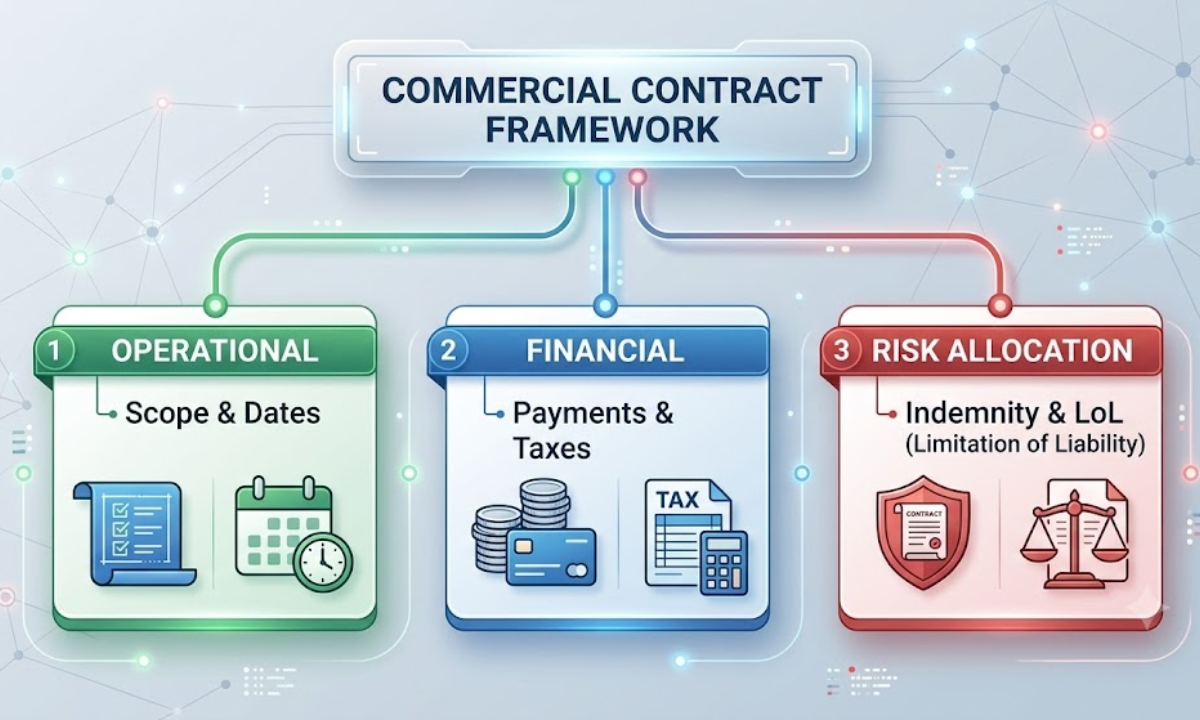
1. Operational Clauses (The Core Mechanics)
These provisions outline exactly what the parties are exchanging. They define the scope of work, service level agreements (SLAs), delivery milestones, timelines, and product specifications. Operational clauses must be written with absolute mathematical and technical precision. Vague definitions of deliverables are the single leading cause of commercial scope creep and post facto execution disputes.
2. Financial Clauses (The Economic Engine)
Financial clauses govern the movement of capital. They detail the price structure, payment schedules, invoicing timelines, late payment interest penalties, and tax responsibilities (such as GST allocation). A sophisticated commercial contract will also include provisions for pricing variations and financial audits, ensuring your company can verify that billing remains perfectly aligned with actual operational delivery.
3. Risk Allocation Clauses (The Defensive Firewalls)
This category is where the true legal engineering takes place. Risk allocation clauses anticipate failure, looking down the line to determine who pays if the partnership collapses. This section houses the heavy-hitting legal mechanisms:
- Indemnification: Determining who bears the cost of third-party claims or regulatory breaches.
- Limitation of Liability (LoL): Capping the maximum financial exposure of a party in the event of a default.
- Termination: Establishing clear, legal exit ramps for material breach or convenience.
4. Boilerplate Clauses (The Administrative Controls)
Often dismissed as standard legal formatting and ignored during reviews, boilerplate provisions are critical administrative controls. They govern how the contract itself is managed, including how notices must be legally served, how amendments must be executed, and how the contract is interpreted by courts if a dispute arises. This category includes the hyper-critical dispute resolution, governing law, and jurisdiction clauses that dictate where and how legal battles will be fought.
Balancing these four categories requires an intensive understanding of how rights and obligations interact.
You cannot optimize your financial terms while leaving your risk allocation clauses completely unhedged. A well-drafted agreement ensures that every operational obligation is backed by a proportional financial reality and a defensive legal shield.
The Fiscal Firewalls: Indemnity, Liability Caps, and Liquidated Damages
The true test of a commercial contract occurs when a deal collapses, a system fails, or a data breach triggers third-party litigation. In these crisis moments, your operational and financial clauses become secondary; your company’s survival depends entirely on your risk allocation framework.
Within the anatomy of Contract Clauses, three distinct fiscal firewalls dictate exactly which corporate balance sheet absorbs the financial damage.
1. The Indemnity Trap door (Shifting the Burden)
Governed by Section 124 of the Indian Contract Act, 1872, an indemnity clause is a highly aggressive legal mechanism. It forces one party (the indemnifier) to completely absorb the legal costs, damages, and judgments incurred by the other party (the indemnitee) due to specific operational failures or third-party lawsuits.
Enterprise clients routinely insert broad, all-encompassing indemnity clauses into their vendor agreements. They will demand that your startup indemnify them against any losses, claims, damages, or expenses arising from the performance of services.
Signing a blanket indemnity without specific carve-outs is commercial suicide. It legally binds your corporate treasury to pay for their legal defense and operational losses, even if the root cause was partially driven by their own negligence.
2. The Limitation of Liability Cap (The Shield)
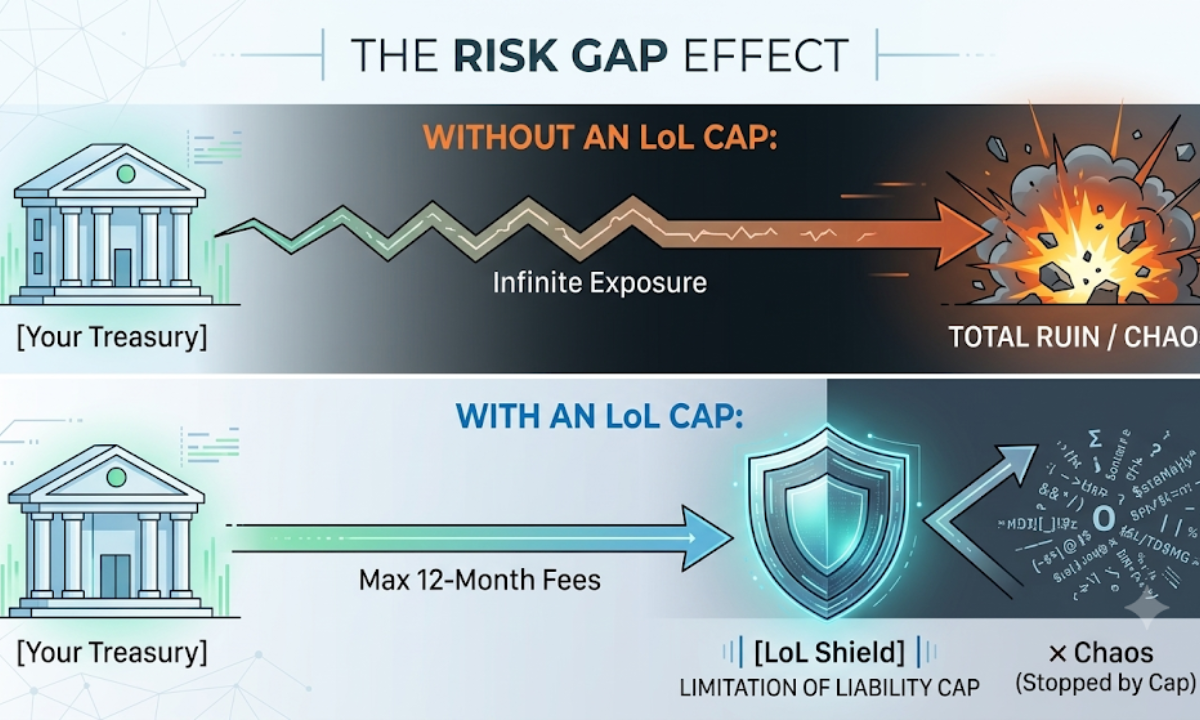
If an indemnity clause is a trapdoor that opens your balance sheet to infinite risk, a Limitation of Liability (LoL) clause is the concrete shield that closes it. The LoL clause establishes a hard financial ceiling on the maximum total damages a party can legally recover in the event of a breach, service outage, or operational failure.
An elite commercial agreement will restrict the total liability of a vendor to a clear, predictable metric, typically the net fees paid by the client under the contract over the preceding 12 months.
Without a hard LoL cap, a minor software bug that disrupts an enterprise client’s daily operations can expose your company to millions in consequential damages, far exceeding the total revenue you generated from the account.
3. Liquidated Damages vs. Penalties
Under Sections 73 and 74 of the Indian Contract Act, commercial agreements frequently predetermine the exact financial payout required if a specific milestone is missed (such as a delayed software deployment).
- Liquidated Damages: These are legally enforceable if they represent a genuine, pre-estimated forecast of the actual loss the non-breaching party will suffer.
- Penalties: If the stated amount is arbitrary, extravagant, or designed strictly to terrorize the performing party into submission, Indian courts will strike it down as an illegal penalty, reducing the payout to only the actual proven damages.
The Risk Matrix: Balancing the Big Three
To ensure your corporate treasury is never exposed to uncapped liability, your transactional attorneys must rigorously negotiate these three clauses as an interconnected system.
| Clause Type | The Danger Mode (Predatory Draft) | The Secure Mode (Escalade Engineered) |
|---|---|---|
| Indemnification | Uncapped, unilateral indemnity covering all direct, indirect, and consequential losses arising from any contract breach. | Strictly limited to direct third-party claims resulting solely from gross negligence, intellectual property infringement, or data privacy violations. |
| Limitation of Liability | Silence (which legally implies uncapped exposure under common law) or exceptions that exclude core services from the cap. | A hard financial cap restricted to the total fees paid under the contract in the preceding 12 months, explicitly mutual for both parties. |
| Consequential Damages | Allowing recovery for lost profits, loss of business opportunity, or reputational damage suffered by the client. | An absolute, explicit waiver stating that neither party shall be liable for indirect, special, incidental, or consequential damages under any circumstances. |
Mastering this matrix ensures that even if a commercial relationship faces catastrophic failure, your company’s maximum financial exposure remains completely predictable, insurable, and incapable of bankrupting your enterprise.
The Operational Shields: IP Allocation, Dispute Resolution, and Contract Management
Beyond the immediate fiscal firewalls, a high-growth enterprise must erect absolute operational shields within its commercial agreements. These provisions govern the ownership of intangible assets during a collaboration and dictate exactly how conflicts are suppressed or resolved when a commercial relationship sours. Without these shields, daily operations can quickly devolve into a chaotic drain on management bandwidth and corporate resources.
1. Intellectual Property (IP) Allocation: Guarding the Core Code
When executing a commercial project such as developing custom software, designing a platform, or generating data analytics for an enterprise client, the contract must explicitly define the boundary lines of IP ownership.
A standard predatory client contract will often feature a clause stating that all intellectual property created during the performance of the contract automatically vests with the client. Signing this without modification can strip your company of its core software modules, framework components, and underlying architectural logic.
An elite commercial contract enforces a strict, dual-layered IP allocation protocol:
- Background IP: All proprietary technologies, software code, pre-existing tools, and methodologies owned by your company before the execution of the contract remain exclusively yours. The client receives only a non-exclusive, non-transferable, limited license to use this background IP solely for the duration of the project.
- Foreground IP: This covers the specific, bespoke deliverables generated explicitly for the client. While the client may own the final outward-facing interface or custom content, your development team must contractually retain ownership over the underlying generic code scripts, libraries, and subroutines used to build it.
2. The Dispute Resolution Architecture: Avoiding Jurisdictional Traps
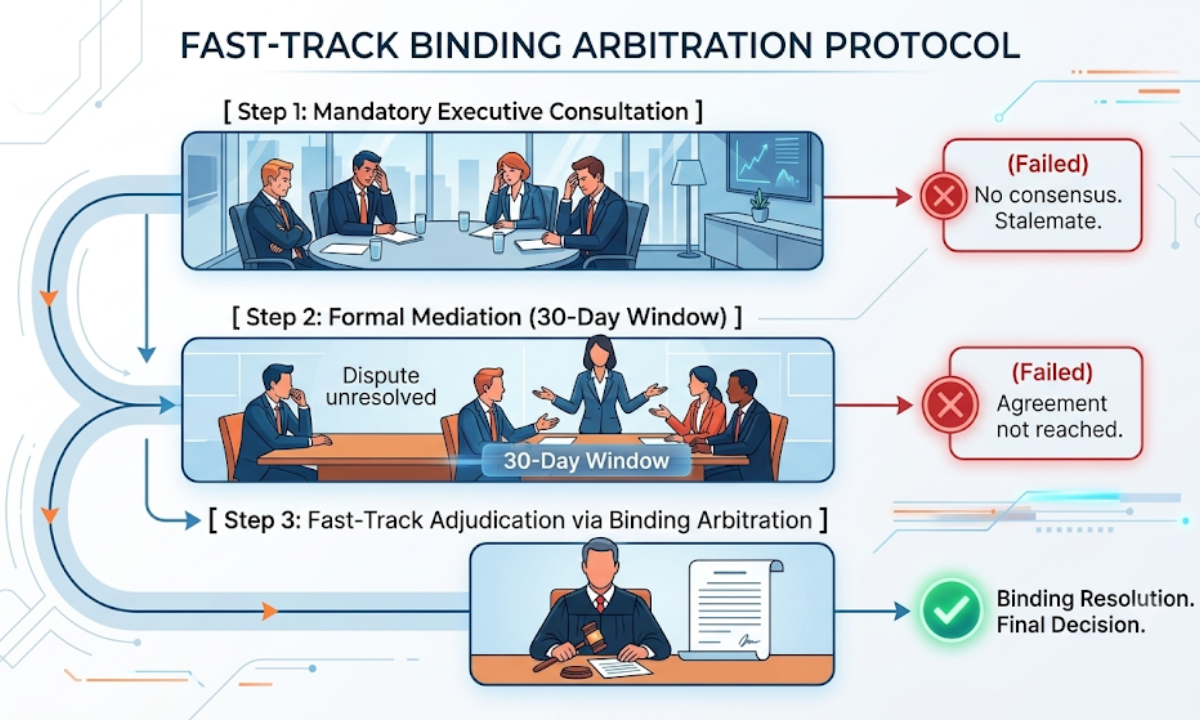
When a commercial dispute arises, the wording of your dispute resolution clause dictates whether you resolve the matter through a structured, private negotiation or find yourself dragged into ruinous, multi-year litigation in an unfavorable court system.
Under the Arbitration and Conciliation Act, 1996, your transactional attorneys must meticulously engineer a multi-tiered dispute resolution framework:
The critical trap that catches most executive boards is failing to distinguish between the Seat and the Venue of arbitration:
- The Seat: This is the legal home of the arbitration. The courts at the designated seat hold exclusive supervisory jurisdiction over the entire dispute, including the power to grant interim injunctions or set aside an award.
- The Venue: This is merely the physical location where the arbitrators happen to meet for hearings.
If your company is based in Bangalore, but you accidentally sign a contract specifying the Seat of arbitration as New Delhi or Mumbai, you will be forced to fly your management team and retain external local counsel in that city just to file an emergency interim application, dramatically increasing your legal expenditures.
3. Proactive Contract Management: Preventing Post-Facto Friction
Even a flawlessly engineered agreement can fail if it is archived in a drawer the moment it is signed. Modern corporate governance requires continuous Contract Management. This involves implementing an internal protocol to monitor critical contract life cycles:
- Milestone Trackers: Automated alerts for delivery timelines, SLA review dates, and notice windows for contract renewal or termination.
- Change Order Protocols: A strict contractual mandate stating that any modification to the project scope, pricing, or timelines is legally void unless executed via a formal, written Change Order signed by authorized signatories of both entities. This eliminates informal scope creep driven by casual email exchanges or verbal requests from client managers.
By establishing these operational shields, your company ensures that its intellectual capital is permanently protected and its legal exposure is tightly managed, permitting the executive team to focus entirely on commercial execution.
Why Choose Escalade Legal Services?
Navigating the high-stakes complexities of commercial contracting requires more than just filling out basic templates or downloading standard boilerplates from the internet. A single poorly drafted phrase can quietly expose your company’s entire treasury to uncapped liabilities or permanently alienate your proprietary assets.
We do not simply review words; we perform precise structural legal engineering. Under the direct leadership of Expert IP Attorney Venkata Raghavan, our team operates as the premier corporate counsel, delivering unmatched Contract drafting and review services in Bangalore.
When you retain Escalade Legal Services to oversee your commercial agreements, your enterprise gains an unassailable operational advantage:
- Custom Risk Allocation Coding: We do not accept predatory client templates. We aggressively negotiate and structure your agreements, embedding ironclad Limitation of Liability (LoL) shields and mutual indemnification frameworks that keep your financial exposure completely capped and predictable.
- Absolute IP Asset Locking: Operating dually as an elite IP law firm in Bangalore, our legal architects construct tight Background and Foreground IP allocation boundaries. We ensure your core codebase, proprietary algorithms, and software modules remain exclusively yours, preventing clients from retaining structural ownership over your innovation.
- Bulletproof Jurisdictional Engineering: We design precise, multi-tiered dispute resolution clauses that insulate your board from jurisdictional traps. Our Corporate lawyers mandate clear local seats of arbitration and fast-track mediation protocols, protecting your management bandwidth and avoiding ruinous out-of-state litigation costs.
We build clarity into your operational mechanics. From defining sharp, measurable Scope of Work parameters to embedding strict written Change Order protocols, we insulate your business from costly scope creep and post facto commercial friction.
Conclusion
Every commercial contract your executive board signs is either an offensive asset that secures your revenue or a ticking financial liability that can compromise your entire enterprise valuation. Viewing contracts as passive administrative formalities is a fatal corporate oversight. The firewalls you construct within your agreements today, your liability caps, indemnification parameters, and intellectual property boundaries are the exact mechanisms that will dictate your company’s survival when a partnership faces operational stress.
Do not allow an ambiguous boilerplate clause or an unhedged indemnity trapdoor to expose your balance sheet to uncapped risk. Take absolute control of your commercial transactions. We invite your leadership team to schedule a comprehensive contract review and structural risk audit at our Escalade Legal office, located on Cunningham Road in Bangalore.
Let our specialized transactional attorneys engineer the ironclad, highly defensive legal frameworks your business requires to scale safely and dominate the marketplace with absolute certainty.