
Quick Answer
Shareholder disputes in India commonly arise from disagreements over business decisions, financial contributions, share transfers, management responsibilities, contractual obligations, and ownership exits. Companies can address these conflicts through negotiation, mediation, arbitration, or legal proceedings. Clear shareholder agreements, transparent governance practices, and defined dispute resolution procedures help prevent prolonged business disagreements.
Introduction
Shareholders may have different expectations about a company’s growth, financial management, business strategy, and future direction. These differences can create disagreements that affect business relationships and daily operations. When shareholders cannot reach an agreement, the conflict may develop into a legal dispute.
In India, shareholder relationships are influenced by the Companies Act, 2013, the company’s Articles of Association (AoA), and contractual agreements between shareholders. A corporate law firm in Bangalore can help businesses review these arrangements, understand their contractual obligations, and identify suitable ways to resolve shareholder conflicts.
Understanding the common causes of shareholder disputes and the available resolution mechanisms can help companies protect business continuity, maintain professional relationships, and reduce the risk of prolonged legal proceedings.
What Are Shareholders’ Disputes?
Shareholders’ disputes are disagreements between two or more shareholders, or between shareholders and company management, concerning business operations, financial decisions, ownership arrangements, or contractual responsibilities.
These disputes can arise in private limited companies, public companies, startups, family-owned businesses, and joint ventures.
Unlike disagreements that can be resolved through routine business discussions, shareholder disputes may involve competing commercial interests, conflicting interpretations of agreements, or a breakdown in trust between business partners.
For example, two founders holding equal shares in a private company may disagree about appointing a new director or investing company funds in a new business opportunity. If their disagreement prevents the company from making important decisions, it can develop into a shareholder deadlock.
The nature of the dispute, the agreements between the parties, and the company’s governing documents determine the appropriate approach to resolution.
Common Causes of Shareholders’ Disputes in India

Shareholder disputes often develop when the parties have different expectations about their financial interests, responsibilities, and involvement in company management.
The following are some common causes.
1. Disagreements Over Business Decisions
Shareholders may have different views about the company’s future direction and business priorities.
For example, one shareholder may support expanding into a new market, while another may prefer to retain existing operations and reduce financial risks.
Such differences can affect important business decisions, including:
- Business expansion and investment plans.
- Appointment of senior management.
- Acquisition of another business.
- Borrowing and financial commitments.
- Changes in business operations.
- Entry into strategic partnerships.
Disagreements become more difficult when the shareholders have equal voting power or when the company’s decision-making procedures are not clearly defined.
A well-structured agreement should distinguish routine operational decisions from major business matters that require approval from multiple shareholders.
2. Breach of Shareholders’ Agreement
A Shareholders’ Agreement (SHA) defines the contractual relationship between shareholders. It generally covers ownership arrangements, voting procedures, management responsibilities, share transfers, exit rights, and dispute resolution.
Disputes may arise when a shareholder fails to comply with the agreed terms.
Common examples include:
- Violating agreed share transfer restrictions.
- Failing to obtain consent before making reserved decisions.
- Breaching confidentiality obligations.
- Ignoring agreed voting arrangements.
- Failing to meet contractual financial commitments.
- Violating exit or buyout provisions.
For instance, an investor may have negotiated approval rights over certain major business decisions. If the other shareholders proceed without following the agreed approval procedure, a contractual dispute may arise.
Companies should ensure that shareholder agreements clearly define each party’s obligations and provide suitable procedures for addressing breaches.
Read our detailed article on What Are Shareholder Agreements? Why They Matter for Growing Businesses to understand the role of these agreements in business ownership and management.
3. Disputes Over Share Transfers and Ownership Changes
Shareholders may decide to sell or transfer their shares because of changes in business interests, financial requirements, retirement, or disagreements with other shareholders.
However, share transfer restrictions and contractual conditions can create conflicts between the parties.
Common disputes include:
- Disagreements over the valuation of shares.
- Refusal to approve a proposed share transfer.
- Failure to follow the right of first refusal (ROFR).
- Disputes over the sale of shares to external investors.
- Disagreements regarding transfer restrictions.
- Conflicts involving tag-along and drag-along rights.
For example, a shareholder may receive an offer from an external investor but be required to offer the shares to existing shareholders first under the applicable agreement.
If the parties disagree about the valuation or transfer procedure, the proposed transaction may be delayed.
Clearly drafted share transfer provisions can reduce uncertainty by explaining the approval process, valuation method, timelines, and rights of existing shareholders.
4. Disagreements Over Financial Contributions and Profit Distribution
Financial disagreements can arise when shareholders have different expectations about their contributions, returns, and financial responsibilities.
For example, one shareholder may contribute additional funds to support business expansion, while another may disagree with the proposed investment or the financial arrangements.
Common issues include:
- Disagreements over additional capital contributions.
- Differences in financial commitments.
- Disputes over dividend policies.
- Disagreements about reinvesting company profits.
- Concerns regarding business expenses and financial reporting.
- Conflicts over the allocation of financial responsibilities.
It is important to distinguish between company profits, shareholder returns, and contractual financial obligations.
A shareholder’s expectation of receiving regular returns does not automatically create an entitlement to dividends. Dividend declarations must follow applicable company law and the company’s financial position.
Companies can reduce these disagreements by establishing clear financial arrangements and documenting the expectations of all shareholders.
5. Conflicts Over Roles and Management Responsibilities
In businesses with multiple founders or shareholders, disagreements may arise when responsibilities and decision-making authority are not clearly defined.
For example, two founders may hold equal ownership, but one may manage daily operations while the other handles financial planning and investor relationships.
Over time, disagreements may develop when one founder believes that the other is not fulfilling their responsibilities or is making decisions beyond their agreed authority.
Common situations include:
- Disagreements over the division of responsibilities.
- Failure to meet agreed business commitments.
- Conflicts over director appointments.
- Disagreements about management authority.
- Unauthorised business decisions.
- Differences in the level of involvement in company operations.
These issues are particularly common in startups and founder-led businesses.
A Founders’ Agreement can establish the responsibilities, equity arrangements, decision-making procedures, and obligations of each founder.
Businesses can also refer to Founder Agreements Explained: How to Protect Equity, Roles and Business Decisions for a better understanding of how these arrangements can reduce disagreements between founders.
6. Shareholder Deadlocks in 50:50 Companies
A shareholder deadlock occurs when shareholders cannot reach an agreement on important company decisions, preventing the business from moving forward.
This situation is particularly common in companies where two shareholders hold equal ownership and voting rights.
For example, two shareholders holding 50% each may disagree about taking a business loan, appointing a director, selling company assets, or expanding operations.
Neither shareholder may have sufficient voting power to move the decision forward independently.
Common causes of shareholder deadlocks include:
- Differences in business objectives.
- Disagreements over financial investments.
- Conflicts regarding management appointments.
- Disputes over business expansion.
- Differences in operational priorities.
- Failure to agree on major commercial transactions.
A prolonged deadlock can delay business decisions, affect employee management, disrupt business relationships, and create financial difficulties.
Companies should include clear deadlock resolution procedures in their Shareholders’ Agreements and Articles of Association. These may include escalation discussions, independent mediation, casting-vote arrangements where appropriate, or agreed buy-sell mechanisms.
7. Disputes Over Exit and Buyout Arrangements
Shareholders may decide to leave a company because of personal circumstances, financial considerations, changes in business priorities, or disagreements with other shareholders.
However, the exit process can become complicated when the parties disagree about the terms of separation.
Common issues include:
- Disagreement over the value of shares.
- Refusal to purchase an outgoing shareholder’s shares.
- Disputes over payment timelines.
- Disagreement about the applicable exit provisions.
- Failure to comply with buyout arrangements.
- Conflicts over the transfer of business interests.
For example, an outgoing shareholder may expect the company or existing shareholders to purchase their shares at a particular valuation. The remaining shareholders may disagree with the valuation or the payment terms.
These disputes can delay the exit process and affect the company’s ownership structure.
Shareholder agreements should establish clear valuation procedures, payment terms, transfer requirements, and exit mechanisms to reduce uncertainty.
Legal Remedies and Resolution Mechanisms for Shareholders’ Disputes
The appropriate approach to resolving a shareholder dispute depends on its nature, the agreements involved, the relief required, and the applicable legal provisions.
Not every commercial disagreement requires court proceedings. Many disputes can be addressed through contractual procedures and alternative dispute resolution mechanisms.
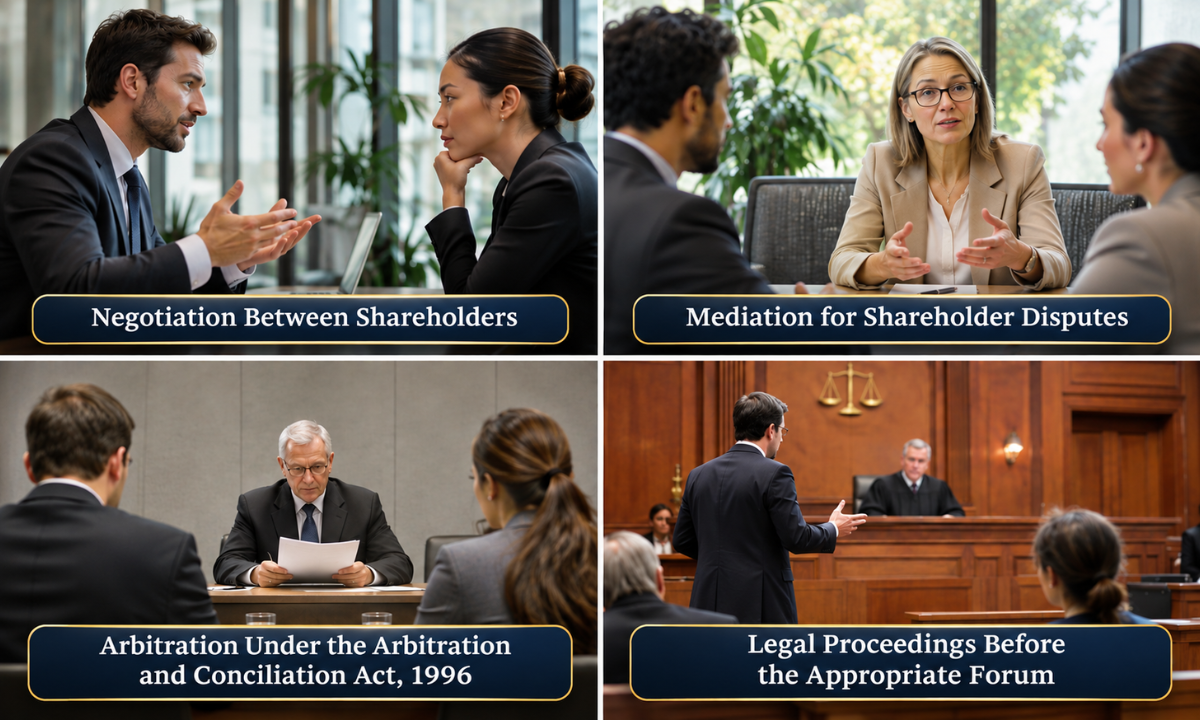
1. Negotiation Between Shareholders
Negotiation is often the first step in resolving shareholder disagreements.
The parties can discuss the issue directly and attempt to reach a mutually acceptable arrangement without initiating formal legal proceedings.
Negotiation may help resolve:
- Disagreements over management responsibilities.
- Differences in business priorities.
- Financial contribution disputes.
- Share valuation disagreements.
- Conflicts over contractual obligations.
For example, shareholders who disagree about business expansion may negotiate revised investment responsibilities or agree on a phased expansion plan.
Any settlement should be properly documented to establish the agreed terms and responsibilities of each party.
2. Mediation for Shareholder Disputes
Mediation involves an independent third party who helps the shareholders communicate, identify their differences, and explore possible solutions.
Unlike an adjudicatory process, the mediator does not decide the dispute. The parties retain control over whether to accept a proposed settlement.
Mediation can be useful when shareholders want to preserve their business relationship or continue working together after resolving the disagreement.
It may help address conflicts involving management responsibilities, financial arrangements, business strategy, and shareholder exits.
Where the parties reach an agreement, the settlement should be recorded in writing with clearly defined obligations and timelines.
3. Arbitration Under the Arbitration and Conciliation Act, 1996
Arbitration is a formal dispute resolution mechanism in which an independent arbitrator or arbitral tribunal decides a dispute and issues an award.
Where a valid arbitration agreement exists, shareholders may refer disputes covered by that agreement to arbitration, subject to applicable law.
Arbitration may be relevant for disputes involving:
- Breach of Shareholders’ Agreements.
- Non-compliance with contractual obligations.
- Share transfer restrictions.
- Valuation and buyout arrangements.
- Contractual exit provisions.
- Disagreements over agreed financial commitments.
The arbitration clause should clearly specify the applicable procedure, appointment of arbitrators, seat of arbitration, and other relevant terms.
However, not every shareholder dispute can be resolved through arbitration. Matters involving statutory remedies or issues reserved for the jurisdiction of the NCLT or another statutory forum require separate legal assessment.
4. Legal Proceedings Before the Appropriate Forum
When negotiations and other resolution mechanisms fail, shareholders may need to consider formal legal proceedings.
The appropriate forum depends on the nature of the dispute.
For example, contractual disputes may involve civil proceedings or arbitration, depending on the agreement and applicable law. Certain matters concerning company management, share transfers, and statutory corporate remedies may fall within the jurisdiction of the NCLT.
The Companies Act, 2013 provides specific remedies for matters such as oppression and mismanagement, refusal to register share transfers, and rectification of the register of members.
These statutory remedies are distinct from ordinary contractual disputes between shareholders.
For a detailed explanation of statutory protections available to minority shareholders, refer to our related article, Minority Shareholder Rights and Remedies Under Indian Company Law.
This article focuses on the practical and contractual causes of shareholder disagreements, while the related article explains the statutory rights and remedies available under Indian company law.
5. Settlement Through Share Buyout or Exit Arrangements
Some shareholder disputes arise because the parties no longer wish to continue their business relationship.
In such situations, a negotiated share buyout or agreed exit may provide a practical solution.
Depending on the company’s structure and applicable legal requirements, possible arrangements include:
- Purchase of the outgoing shareholder’s shares by existing shareholders.
- Transfer of shares to an agreed third party.
- Implementation of contractual buy-sell provisions.
- Settlement of outstanding financial obligations.
- Agreed separation of business interests.
The parties should address share valuation, payment terms, transfer documentation, applicable approvals, and other contractual obligations before completing the transaction.
A properly structured exit arrangement can help prevent recurring disagreements and provide greater certainty to the remaining shareholders.
How Can Companies Prevent Shareholders’ Disputes?
Preventive legal arrangements can reduce the risk of shareholder conflicts and help companies maintain stable business relationships.
The following practices can help businesses manage shareholder expectations.

1. Prepare a Comprehensive Shareholders’ Agreement
A Shareholders’ Agreement should clearly define ownership arrangements, voting procedures, financial commitments, share transfer restrictions, exit rights, and dispute resolution mechanisms.
The agreement should reflect the company’s actual ownership structure and commercial arrangements.
2. Define Roles and Responsibilities
Shareholders who are actively involved in management should have clearly defined responsibilities and decision-making authority.
This helps prevent disagreements over operational control, management performance, and business commitments.
3. Establish Clear Decision-Making Procedures
Companies should identify which decisions can be taken by management and which require shareholder approval.
Reserved matters, voting requirements, approval thresholds, and deadlock resolution procedures should be documented clearly.
4. Maintain Transparent Financial Records
Companies should maintain accurate financial statements, transaction records, board minutes, and relevant shareholder communications.
Transparent financial reporting can reduce misunderstandings about company expenses, investments, and financial commitments.
5. Define Share Transfer and Exit Procedures
Shareholders should agree on the procedures for selling shares, bringing in new investors, and exiting the company.
Valuation methods, transfer restrictions, consent requirements, and payment timelines should be addressed in advance.
6. Follow Appropriate Corporate Governance Practices
Companies should maintain proper internal procedures for board meetings, shareholder meetings, approvals, and corporate documentation.
Clear governance arrangements help ensure that business decisions are made through established procedures rather than informal understandings.
Read more about corporate governance and compliance and its role in maintaining effective business management.
How Can a Corporate Lawyer Help Resolve Shareholders’ Disputes?

Shareholder disputes often involve overlapping issues relating to company law, contractual obligations, ownership rights, and corporate governance. Professional legal assistance can help shareholders and businesses identify their rights and choose an appropriate course of action.
A corporate lawyer can assist with:
- Reviewing Shareholders’ Agreements and Articles of Association.
- Identifying contractual breaches and disagreements.
- Advising on share transfers, valuation, and exit arrangements.
- Reviewing management and decision-making disputes.
- Drafting settlement agreements and revised contractual arrangements.
- Advising on negotiation and mediation.
- Representing clients in arbitration and appropriate legal proceedings.
- Drafting dispute resolution and deadlock clauses.
- Advising companies on preventive corporate governance measures.
Early legal assessment can help shareholders understand their contractual position, preserve relevant documents, and identify practical options for resolving disagreements.
Conclusion
Shareholders’ disputes can arise from differences in business objectives, financial expectations, management responsibilities, contractual obligations, and ownership arrangements. If these disagreements are not addressed properly, they can affect business operations, delay important decisions, and damage relationships between shareholders.
Clear Shareholders’ Agreements, defined exit procedures, transparent financial arrangements, and effective corporate governance can help prevent many of these conflicts. When disagreements arise, negotiation, mediation, arbitration, or appropriate legal proceedings may provide a way forward.
Understanding the nature of a dispute and selecting the right resolution mechanism can help companies protect business continuity while addressing the interests of the parties involved.
Frequently Asked Questions
1. What are the most common causes of shareholder disputes in India?
Common causes include disagreements over business decisions, financial contributions, management responsibilities, share transfers, contractual obligations, dividend policies, and shareholder exit arrangements.
2. Can shareholders resolve disputes without going to court?
Yes. Shareholders can attempt to resolve disagreements through direct negotiation, mediation, or arbitration where a valid arbitration agreement exists and the dispute is legally arbitrable. Contractual settlements and agreed share buyouts may also help resolve certain conflicts.
3. What happens when two shareholders holding 50% shares each disagree?
A disagreement between two equal shareholders can create a management deadlock if neither can secure the required approval for important decisions. The shareholders should follow the deadlock resolution procedure in their agreement or consider negotiation, mediation, arbitration where applicable, or other legally available remedies.
4. How does a Shareholders’ Agreement help prevent disputes?
A Shareholders’ Agreement establishes the rights and responsibilities of shareholders. It can address voting procedures, management participation, financial commitments, share transfer restrictions, exit arrangements, and dispute resolution mechanisms.
5. Can a shareholder force another shareholder to sell their shares?
A shareholder cannot generally force another shareholder to sell shares simply because of a disagreement. Such a right may arise under specific contractual provisions, including applicable buy-sell or drag-along arrangements, or through an appropriate legal order. The agreement and circumstances must be examined.
6. What is the difference between mediation and arbitration in shareholder disputes?
Mediation is a facilitated negotiation process in which an independent mediator helps the parties reach a voluntary settlement. Arbitration involves an independent arbitrator or tribunal that decides the dispute and issues an award, subject to applicable law.
7. When should a company seek legal assistance for a shareholder dispute?
A company should consider legal assistance when disagreements affect business operations, involve contractual breaches, create management deadlocks, delay share transfers, or lead to disputes over ownership and financial obligations. Early advice can help identify the appropriate resolution process and reduce further complications.