
Introduction
Indemnity clauses allocate specified losses between contracting parties while limitation of liability clauses establish financial limits on recoverable claims. Their interaction determines whether indemnity obligations fall within a general liability cap, operate under a separate cap or remain outside those limits through clearly drafted carve-outs and subject to applicable law.
Businesses negotiating these provisions may benefit from commercial agreement drafting and review services to understand how contractual risk allocation affects their financial and legal obligations.
In commercial transactions, indemnity and limitation of liability clauses often appear together. However, including both provisions does not automatically establish how they operate in relation to each other.
For example: a service provider may agree to indemnify a customer against third-party intellectual property infringement claims while also negotiating a contractual limit on its overall financial liability.
The difficulty arises when the agreement does not clearly state whether indemnity obligations fall within the liability cap. This can create disputes when a claim involves intellectual property infringement, confidentiality breaches, data protection violations or other contractual obligations.
Understanding how these provisions interact is essential when negotiating commercial agreements.
What Is an Indemnity Clause in a Commercial Agreement?
An indemnity clause is a contractual provision under which one party agrees to compensate another for specified losses, liabilities, damages or expenses arising from defined events.
Under Section 124 of the Indian Contract Act, 1872, a contract of indemnity involves one party promising to protect another against loss caused by the conduct of the promisor or another person.
Section 125 addresses the rights of an indemnity holder, including recovery of qualifying damages, legal costs and amounts paid under certain compromises, subject to the conditions specified in the provision.
In commercial agreements, indemnity provisions allocate responsibility for risks that one party may be better positioned to prevent, manage or control.
For example, a software development company may agree to indemnify its customer against third-party intellectual property infringement claims arising from the company’s unauthorised use of protected software or materials.
Similarly, a supplier may agree to indemnify a purchaser against specified losses arising from defective products, third-party claims or breaches of agreed regulatory obligations.
Common Types of Indemnity Obligations
Commercial agreements may include indemnities covering:
- Intellectual property infringement: Claims arising from the unauthorised use of third-party patents, trademarks, copyrights or other protected rights.
- Third-party claims: Losses arising from claims brought by customers, employees, vendors or other external parties.
- Confidentiality breaches: Losses resulting from unauthorised disclosure or misuse of confidential information.
- Data protection violations: Specified liabilities arising from a party’s failure to meet contractual data protection obligations.
- Regulatory non-compliance: Losses arising from defined violations of applicable laws or regulatory requirements.
- Property damage and personal injury: Claims resulting from specified acts, omissions or negligence.
The scope of an indemnity depends on the contractual language. A broadly worded indemnity may cover several categories of loss, while a narrowly drafted provision may apply only to specific events.
What Is a Limitation of Liability Clause?
A limitation of liability clause establishes the extent to which a party can be held financially responsible for losses arising from a commercial agreement.
It may impose a maximum monetary limit on liability, exclude certain categories of damages or establish different financial limits for different types of contractual claims.
For example, a technology services agreement may limit the service provider’s aggregate liability to the fees paid by the customer during the preceding 12 months.
The purpose is to make contractual risk more predictable. Both parties can assess their potential financial exposure before entering into a transaction.
Common Types of Liability Limitations
1. Aggregate Liability Cap
An aggregate liability cap establishes the maximum amount a party must pay for covered claims during a specified period or under the agreement.
For example, if the liability cap is ₹50 lakh, the party’s total liability for claims falling within that cap cannot exceed ₹50 lakh, subject to the contract’s terms and applicable law.
2. Exclusion of Certain Damages
Some agreements exclude specified categories of loss, such as indirect, incidental, special or consequential damages, subject to applicable legal principles and the wording of the exclusion.
The agreement should clarify which losses are excluded rather than relying on broad expressions that may create interpretation disputes.
3. Separate Liability Caps
Parties may negotiate different financial limits for different obligations.
For instance, ordinary contractual breaches may be subject to a general liability cap, while confidentiality or data protection breaches may have a higher separate cap.
4. Unlimited Liability for Specified Events
Some agreements exclude particular events from the liability cap. These are commonly referred to as liability carve-outs.
Fraud, wilful misconduct, confidentiality breaches and intellectual property infringement are examples of matters parties may negotiate as exceptions.
Whether a particular exception is enforceable depends on the agreement and applicable law.
Indemnity vs. Limitation of Liability: Key Differences
Although both clauses address contractual risk, they serve different purposes.
| Basis | Indemnity Clause | Limitation of Liability Clause |
|---|---|---|
| Primary purpose | Allocates responsibility for specified losses | Restricts financial exposure |
| Function | Requires compensation for covered losses | Establishes financial limits or exclusions |
| Scope | Applies to defined indemnity events | Applies to liability categories specified in the agreement |
| Third-party claims | Often addresses specified third-party claims | Determines whether resulting liability is capped or excluded |
| Financial exposure | Depends on the indemnity wording and applicable limits | Depends on the agreed cap and carve-outs |
| Risk allocation | Identifies which party bears specified risks | Determines the maximum exposure for covered claims |
The important distinction is that an indemnity creates a contractual obligation to compensate for defined losses, whereas a limitation of liability clause determines the extent of financial responsibility.
The two provisions must therefore be interpreted together.
Businesses reviewing different contractual provisions should also understand the key clauses in commercial contracts, particularly where multiple provisions affect the same contractual obligation.
Does an Indemnity Obligation Fall Within the Liability Cap?

This is one of the most important issues when negotiating commercial agreements.
An indemnity clause does not automatically operate outside a contractual liability cap. Equally, a general liability cap does not necessarily resolve every question concerning indemnity obligations.
The outcome depends on how the agreement connects the two provisions.
Consider a software development agreement between a technology company and a business customer.
The agreement contains the following provisions:
- The service provider must indemnify the customer against third-party intellectual property infringement claims arising from the provider’s work.
- The agreement limits the service provider’s aggregate liability to ₹50 lakh.
- The limitation clause does not expressly state whether indemnity obligations are included or excluded.
Suppose a third party brings an intellectual property infringement claim against the customer, resulting in a qualifying indemnity claim of ₹80 lakh.
The parties may disagree about whether the service provider’s indemnity obligation is restricted to ₹50 lakh or whether the entire qualifying indemnity amount can be recovered.
The disagreement arises because the contract does not clearly establish the relationship between the indemnity provision and the liability cap.
Scenario 1: Indemnity Obligations Are Included Within the Liability Cap
If the agreement expressly states that all indemnity obligations are subject to the aggregate liability cap, indemnity payments will generally be included within that agreed limit, subject to applicable law and any other contractual exceptions.
For example:
- General liability cap: ₹50 lakh
- Qualifying indemnity claim: ₹80 lakh
- Applicable liability cap: ₹50 lakh
If the indemnity is fully subject to the cap, the recoverable amount under that provision would generally be restricted to ₹50 lakh.
This arrangement gives the indemnifying party greater certainty about its maximum contractual exposure.
However, the indemnified party may face a shortfall if the actual qualifying loss exceeds the agreed cap.
Scenario 2: Indemnity Obligations Are Excluded From the General Liability Cap
The parties may expressly exclude specified indemnity obligations from the general liability cap.
For example, the agreement may state that indemnification obligations arising from third-party intellectual property infringement claims are not subject to the general aggregate liability cap.
In this situation:
- General liability cap: ₹50 lakh
- Qualifying intellectual property indemnity claim: ₹80 lakh
- General cap applicable to the specified indemnity: No
The indemnity obligation may extend beyond the general liability cap, subject to its scope, applicable defences and any other financial limitations in the agreement.
Importantly, exclusion from the general cap does not automatically mean unlimited liability. The agreement may still contain a separate indemnity cap or other applicable restrictions.
Scenario 3: Indemnity Obligations Have a Separate Liability Cap
Parties may also negotiate a separate financial limit for indemnity obligations.
For example:
- General liability cap: ₹50 lakh
- Indemnity liability cap: ₹1 crore
- Qualifying indemnity claim: ₹80 lakh
Here, ordinary contractual liability is restricted to ₹50 lakh, while specified indemnity obligations are subject to a separate cap of ₹1 crore.
The qualifying indemnity claim of ₹80 lakh would fall within the separate indemnity cap, assuming the claim satisfies the contractual requirements.
This approach can provide a balance between financial predictability and protection against significant third-party claims.
The agreement should clearly define which indemnity obligations fall under the separate cap and whether the cap applies on an aggregate basis or per claim.
What Are Liability Carve-Outs in Commercial Agreements?
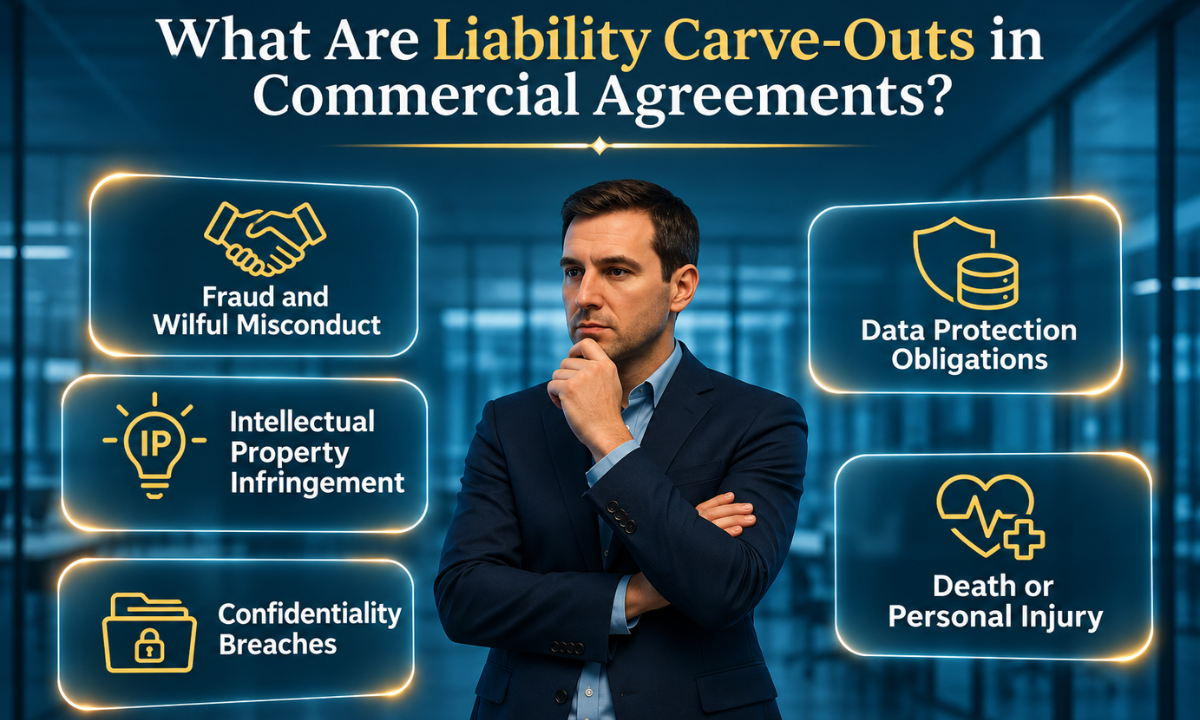
Liability carve-outs are specific exceptions to the general limitation of liability provisions.
They identify circumstances in which a party cannot rely on the ordinary liability cap or certain exclusions of damages.
The purpose is to ensure that particularly serious or sensitive contractual risks receive separate treatment.
Commonly negotiated carve-outs include:
1. Fraud and Wilful Misconduct
Parties may exclude liability arising from fraud or wilful misconduct from the general liability cap.
Such provisions require careful drafting because contractual wording cannot automatically override applicable statutory restrictions or public policy considerations.
2. Intellectual Property Infringement
Intellectual property indemnities may be excluded from the general liability cap because infringement claims can result in substantial financial exposure.
A separate cap may also be negotiated depending on the nature of the transaction and the parties’ risk tolerance.
3. Confidentiality Breaches
Unauthorised disclosure of confidential information may cause financial and commercial damage that is difficult to estimate when the agreement is signed.
For this reason, parties may negotiate a separate liability cap or exclude specified confidentiality breaches from the general cap.
4. Data Protection Obligations
Commercial agreements involving personal data may include separate liability provisions for defined data protection breaches.
The parties should consider the nature of the data, their respective responsibilities, applicable regulatory obligations and the potential consequences of non-compliance.
5. Death or Personal Injury
Parties may also negotiate exceptions for liability arising from death or personal injury caused by specified acts or omissions.
The drafting must account for applicable legal restrictions and cannot be assumed to exclude liability that the law does not permit parties to contract out of.
A carefully drafted carve-out should identify the specific obligations and claims covered by the exception. Simply stating that all indemnities are excluded from the liability cap may create unnecessary uncertainty.
Key Drafting Issues When Indemnity and Liability Caps Interact
When preparing commercial agreements, businesses should pay attention to how indemnity and limitation of liability provisions operate together.
The following issues deserve particular attention.
1. Clearly State Whether Indemnities Are Subject to the Liability Cap
The agreement should expressly address whether indemnity obligations fall within the general liability cap, a separate cap or an uncapped category.
Avoid relying on assumptions or broad references to aggregate liability.
2. Define the Scope of Indemnified Losses
The indemnity provision should identify the types of claims, losses, damages, costs and expenses covered.
It should also clarify whether the provision applies to third-party claims, direct losses or both.
3. Establish a Clear Claims Procedure
Indemnity provisions should explain how a party must notify the other party of a claim.
They should also address:
- The time and manner of providing notice.
- Responsibility for defending third-party claims.
- Control over legal proceedings and negotiations.
- Approval requirements for settlements.
- Cooperation and access to relevant information.
Without a clear procedure, disagreements may arise over who controls the defence and who bears the resulting costs.
4. Address Consequential and Indirect Losses
The limitation of liability clause may exclude consequential or indirect losses, while the indemnity clause may cover certain losses arising from third-party claims.
The agreement should clarify whether the exclusion applies to indemnity claims and how specific indemnified amounts are treated.
The parties should not assume that describing a loss as an indemnified loss automatically removes it from every contractual exclusion.
5. Clarify the Meaning of Aggregate Liability
The agreement should specify whether the liability cap applies to:
- Each individual claims.
- All claims arising from a single event.
- All claims during a defined period.
- The entire duration of the agreement.
It should also clarify whether payments made under the indemnity provision reduce the remaining amount available under the general liability cap.
6. Review the Survival of Indemnity Obligations
Some indemnity obligations may need to continue after the agreement expires or is terminated.
For example, third-party intellectual property claims may arise after the relevant services have been completed.
The agreement should specify which indemnities survive termination, how long they remain enforceable and whether applicable limitation periods or contractual claim procedures affect their operation.
Common Drafting Mistakes to Avoid
When reviewing indemnity and liability provisions, businesses should avoid the following mistakes:
- Conflicting provisions: The indemnity clause promises broad compensation, while the limitation clause restricts all contractual liabilities without addressing indemnities.
- Undefined indemnity scope: The agreement does not specify whether indemnity covers direct losses, third-party claims or both.
- Unclear carve-outs: The agreement excludes indemnities from the liability cap without identifying which indemnity obligations are covered.
- Missing defence procedures: The contract does not explain who manages third-party claims or approves settlements.
- Inconsistent financial limits: Different categories of liability are not assigned clearly defined caps.
- Overlooking applicable law: The parties assume that every limitation or exclusion will be enforceable simply because it appears in a signed agreement.
These issues can make it difficult to determine the financial responsibility of each party when a contractual dispute arises.
Legal Framework Governing Indemnity and Liability Limitations in India
Commercial indemnity and liability limitation provisions in India must be considered in the context of the Indian Contract Act, 1872.
The following statutory provisions are relevant to understanding contractual indemnities, damages and the enforcement of contractual obligations.
Section 124: Contract of Indemnity
Section 124 defines a contract of indemnity and establishes the statutory foundation for indemnification obligations. It is relevant when determining the nature and scope of an indemnity arrangement.
Section 125: Rights of the Indemnity Holder
Section 125 addresses the recovery of qualifying damages, legal costs and amounts paid under certain compromises by an indemnity holder.
Recovery is subject to the conditions specified in the section, including the indemnity holder acting within the scope of their authority and not acting contrary to the indemnitor’s instructions.
Section 23: Lawful Consideration and Objects
Section 23 addresses agreements involving unlawful consideration or objects. Contractual provisions must not involve consideration or objects that are unlawful under the provision.
Section 28: Agreements in Restraint of Legal Proceedings
Section 28 addresses contractual provisions that restrict a party’s ability to enforce its rights through ordinary legal proceedings or impose certain prohibited time limits on enforcement.
It also addresses provisions that extinguish contractual rights or discharge a party from liability after a specified period where this restricts the enforcement of rights.
This provision may become relevant when a commercial agreement contains clauses that attempt to extinguish contractual rights or restrict the enforcement of claims within a specified period.
However, Section 28 should not be treated as a general provision governing the enforceability of monetary liability caps.
Section 73: Compensation for Loss or Damage Caused by Breach of Contract
Section 73 addresses compensation for losses arising naturally from a breach of contract or those that the parties knew were likely to result from the breach.
It also addresses the principles governing remoteness of damage and mitigation of loss.
These provisions provide the legal context for contractual indemnities, damages and liability limitations. However, the enforceability and interpretation of a particular liability cap or indemnity carve-out depend on its wording, the circumstances of the transaction and applicable legal principles.
Businesses should therefore avoid treating a contractual liability cap as automatically enforceable in every situation.
Conclusion
Indemnity and limitation of liability clauses serve different but closely connected purposes in commercial agreements. An indemnity provision determines which losses one party must compensate, while a liability limitation provision determines the extent of that party’s financial exposure.
The most important consideration is whether indemnity obligations fall within the general liability cap, operate under a separate cap or are excluded through clearly defined carve-outs.
Businesses should ensure that these provisions are consistent, specific and aligned with the commercial risks involved in the transaction. Professional commercial agreement drafting and review services can help businesses identify conflicting provisions and establish clear contractual risk allocation.
Frequently Asked Questions
1. Is an indemnity clause the same as a limitation of liability clause?
No. An indemnity clause requires one party to compensate another for specified losses. A limitation of liability clause restricts the financial exposure of a party by establishing monetary caps or excluding certain categories of damages.
2. Are indemnity obligations automatically excluded from a liability cap?
No. Indemnity obligations are not automatically excluded from a contractual liability cap. The agreement should expressly state whether indemnities are subject to the general cap, a separate cap or specified exceptions.
3. Can an indemnity clause have a separate liability cap?
Yes. Parties may negotiate a separate financial limit for specific indemnity obligations. This allows them to distinguish ordinary contractual liability from higher-risk obligations such as intellectual property infringement or confidentiality breaches.
4. What is an indemnity carve-out?
An indemnity carve-out is a provision that excludes specified indemnification obligations from the general limitation of liability clause. It may allow those obligations to operate under a separate financial limit or without a monetary cap, depending on the agreement.
5. What happens if an indemnity clause conflicts with a limitation of liability clause?
A conflict may create uncertainty about the parties’ financial obligations. The interpretation will depend on the language of the agreement, the relationship between its provisions, the circumstances of the transaction and applicable law. Clear drafting can help prevent such disputes.
6. What sections of the Indian Contract Act, 1872 are relevant to indemnity clauses?
Sections 124 and 125 are directly relevant to contracts of indemnity. Sections 23, 28 and 73 may also be relevant when examining the legality of contractual provisions, enforcement of rights and compensation for breach of contract.