
Quick Answer
Share transfer restrictions in private limited companies regulate how shareholders can sell or transfer their shares. Under the Companies Act, 2013, a private company must restrict the right to transfer its shares through its Articles of Association. Common mechanisms include the Right of First Refusal (ROFR), pre-emption rights and consent requirements. These restrictions help protect the company’s ownership structure and the interests of existing shareholders.
Introduction
Share transfer restrictions are important for maintaining control over the ownership of a private limited company. They help existing shareholders manage who can acquire shares and establish a clear process when a shareholder wants to exit. Businesses should understand these restrictions while drafting their Articles of Association (AoA) and shareholders’ agreements. A corporate law firm in Bangalore can help businesses structure these arrangements in line with the Companies Act, 2013.
Unlike public companies, private limited companies have restrictions on the transfer of shares. These restrictions are intended to maintain a closely held ownership structure. However, they must be properly documented and applied in accordance with applicable law.
What Are Share Transfer Restrictions in a Private Limited Company?
The Companies Act, 2013 provides the legal framework for share transfers in private limited companies. Certain provisions are particularly relevant.
Section 2(68): Definition of a Private Company
Section 2(68) defines a private company as one whose Articles of Association:
- Restrict the right to transfer its shares.
- Limit the number of members to 200, subject to the statutory exceptions.
- Prohibit invitations to the public to subscribe to its securities.
The restriction on share transfers is one of the defining features of a private limited company. The AoA must therefore contain provisions governing how shares can be transferred.
Section 44: Nature of Shares
Section 44 states that shares and other interests of members in a company are movable property. They are transferable in the manner provided by the company’s Articles of Association.
This means that share transfers must follow the procedures and restrictions set out in the AoA, along with applicable legal requirements.
Section 56: Transfer and Transmission of Securities
Section 56 deals with the transfer and transmission of securities. It sets out the requirements for executing and delivering the prescribed transfer instrument, where applicable, and completing the transfer process.
For physical share transfers, the prescribed instrument is generally Form SH-4. The parties must also comply with the applicable procedural and documentation requirements.
Section 58: Refusal of Registration and Appeal
Section 58 addresses the refusal to register a share transfer and the remedies available to the affected parties. A private company may refuse registration in accordance with its Articles of Association and applicable law. It must communicate the reasons for refusal within the prescribed period.
The section also provides a mechanism for appealing against the refusal. Importantly, Section 58(2) recognises the enforceability of contracts or arrangements between two or more persons concerning the transfer of securities.
Role of the Articles of Association in Share Transfer Restrictions

The Articles of Association form the company’s internal governing document. They define the rights and obligations of the company and its members, including the procedures for transferring shares.
A private limited company may include provisions such as:
- Prior approval: Requiring approval from the board or shareholders before a transfer can proceed, subject to applicable law.
- Right of First Refusal: Giving existing shareholders the opportunity to purchase shares before they are transferred to an outside buyer.
- Pre-emption rights: Providing existing shareholders with a priority opportunity to acquire shares in specified circumstances.
- Permitted transfers: Identifying transfers that may be allowed without following the usual restrictions, such as certain transfers to family members or group entities.
- Valuation procedures: Establishing how the price of shares will be determined when a transfer takes place.
These provisions should be drafted clearly. Unclear or conflicting clauses can lead to disagreements among shareholders and difficulties when the company processes a transfer.
How Does a Shareholders’ Agreement Regulate Share Transfers?

A Shareholders’ Agreement (SHA) is a contract between some or all shareholders of a company. It sets out their rights, responsibilities and agreed procedures for managing their relationship.
A shareholders’ agreement can include provisions relating to share transfers, exit rights, voting arrangements and investor protections. For example, it may require a shareholder who intends to sell shares to offer them to existing shareholders first.
However, the AoA and SHA should be reviewed together. If a transfer restriction is intended to govern the company’s actions, it is important to ensure that the relevant provision is appropriately reflected in the AoA. Section 58(2) also recognises the enforceability of contracts or arrangements between persons concerning the transfer of securities.
The Supreme Court’s decision in 1992 is relevant to this issue. The Court considered whether a restriction agreed between shareholders, but not included in the Articles of Association, could bind the company or its shareholders. The decision highlights the importance of aligning share transfer provisions in the company’s constitutional documents with the arrangements agreed between shareholders.
For a broader understanding of these agreements, read What Are Shareholder Agreements? Why They Matter for Growing Businesses.
Therefore, companies should ensure that share transfer restrictions are properly documented in their Articles of Association and shareholders’ agreements. This helps establish clear obligations between shareholders and provides a framework for the company to regulate share transfers in accordance with applicable law.
Common Share Transfer Restrictions in Private Limited Companies
Companies use different mechanisms to regulate share transfers. The choice depends on their ownership structure, investment arrangements and business objectives.
1. Right of First Refusal (ROFR)
A Right of First Refusal gives existing shareholders the opportunity to purchase shares before the selling shareholder transfers them to an outside buyer.
For example: if a shareholder receives an offer from a third party, the ROFR clause may require the shareholder to first offer those shares to the existing shareholders on the same terms. If the existing shareholders do not exercise their rights within the specified period, the seller may proceed with the proposed external transfer, subject to the agreement and the AoA.
2. Pre-emption Rights
Pre-emption rights give existing shareholders priority when shares are offered for sale or when a company proposes to issue new shares, depending on how the rights are drafted.
In the context of share transfers, these rights can help existing shareholders maintain their ownership percentage and reduce the possibility of unwanted third parties entering the company.
The agreement should clearly specify when these rights apply, how shareholders can exercise them and the time allowed for responding.
3. Right of First Offer (ROFO)
A Right of First Offer requires a shareholder who intends to sell shares to offer them to existing shareholders before approaching an outside buyer.
Unlike a ROFR, which generally operates after the seller receives an external offer, a ROFO operates before the seller negotiates with a third party. The agreement should define the offer process, pricing method and period for acceptance.
4. Tag-Along Rights
Tag-along rights protect minority shareholders when a majority shareholder proposes to sell shares to a third party.
Under this provision, minority shareholders may have the right to participate in the sale and sell their shares on the same or agreed terms. This helps prevent minority shareholders from being left with a new controlling shareholder they did not choose.
5. Drag-Along Rights
Drag-along rights allow specified majority shareholders to require minority shareholders to participate in a sale of the company or its shares, subject to the agreed conditions.
This provision can help complete a proposed acquisition without individual minority shareholders blocking the transaction. The agreement should clearly define the approval threshold, sale conditions and obligations of the shareholders.
Common Mistakes When Drafting Share Transfer Restrictions
Poorly drafted provisions can create uncertainty and disputes. Companies should avoid the following issues:
- Not aligning the AoA and SHA: Different or conflicting provisions can make it difficult to determine how a transfer should be handled.
- Using unclear language: Vague conditions, timelines and approval requirements can lead to disagreements.
- Ignoring valuation methods: Without a clear valuation process, shareholders may dispute the price of shares during an exit.
- Overlooking permitted transfers: The documents should clarify whether transfers to family members, affiliates or group entities are allowed.
- Not defining the procedure: The documents should specify how notices are issued, how rights are exercised and what happens if shareholders do not respond within the stated period.
Steps to Follow When Transferring Shares
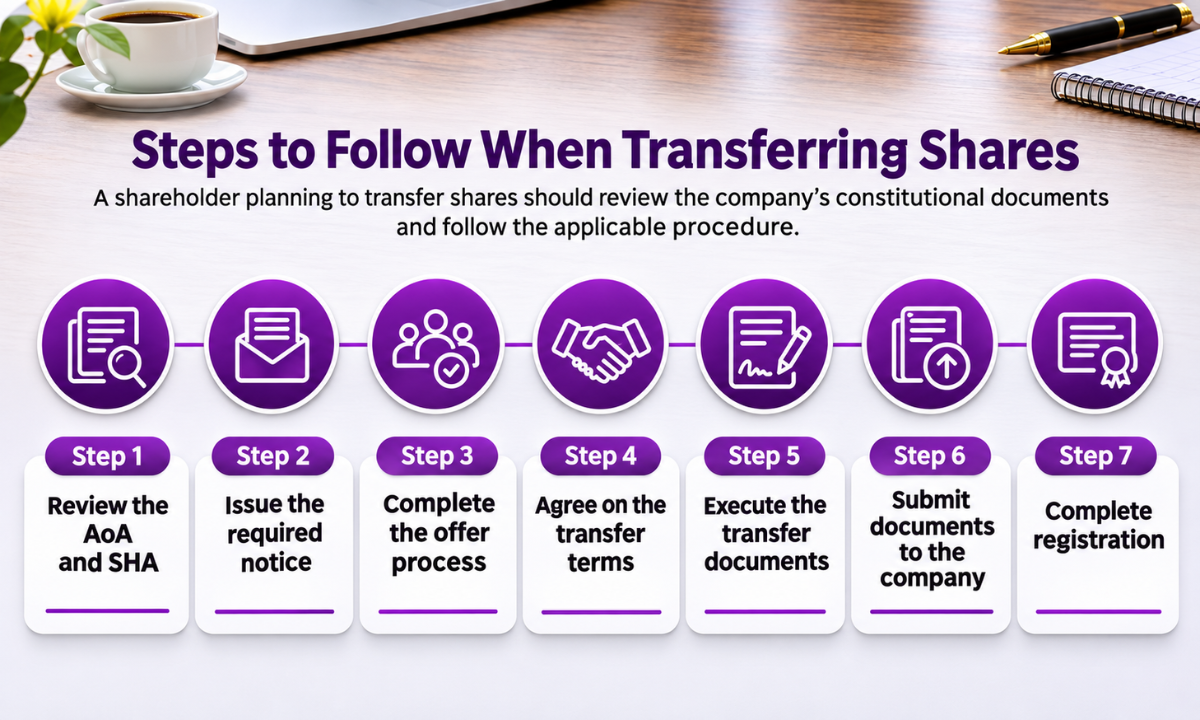
A shareholder planning to transfer shares should review the company’s constitutional documents and follow the applicable procedure.
- Review the AoA and SHA: Check the transfer restrictions, approval requirements and any rights available to existing shareholders.
- Issue the required notice: Inform the relevant parties about the proposed transfer in the manner specified in the documents.
- Complete the offer process: Allow eligible shareholders to exercise their ROFR or pre-emption rights within the agreed period.
- Agree on the transfer terms: Finalise the price, payment terms and other conditions with the proposed transferee.
- Execute the transfer documents: Complete the prescribed transfer instrument and other applicable documentation.
- Submit documents to the company: Deliver the required documents and certificates to the company for processing.
- Complete registration: The company should consider the transfer in accordance with its AoA and applicable provisions of the Companies Act, 2013.
The exact procedure may differ depending on the company’s Articles of Association, the nature of the securities and whether the shares are held in physical or dematerialised form.
Why Legal Review Is Important
Share transfer restrictions affect ownership, control and the future management of a company. A poorly drafted clause may create disputes when a shareholder wants to exit, an investor enters the company or the business undergoes restructuring.
Legal review can help companies:
- Draft clear and workable share transfer provisions.
- Align the Articles of Association with shareholders’ agreements.
- Define ROFR, ROFO and pre-emption procedures.
- Establish appropriate valuation and approval mechanisms.
- Identify potential conflicts between contractual arrangements and company documents.
Businesses requiring assistance with these arrangements may refer to contract drafting and review services in Bangalore.
Conclusion
Share transfer restrictions help private limited companies maintain control over their ownership structure and manage changes in shareholding. The Companies Act, 2013, the Articles of Association and shareholders’ agreements provide the framework for establishing and implementing these restrictions.
Companies should clearly document rights such as ROFR, ROFO, pre-emption, tag-along and drag-along provisions. They should also ensure that the relevant documents are consistent and that every transfer follows the applicable legal and procedural requirements.
Frequently Asked Questions
1. Can shares be freely transferred in a private limited company in India?
No. A private limited company must restrict the right to transfer its shares through its Articles of Association under Section 2(68) of the Companies Act, 2013. Any transfer must follow the applicable provisions in the AoA and the law.
2. Is a shareholders’ agreement sufficient to restrict share transfers?
A shareholders’ agreement can create contractual obligations between its parties. However, companies should ensure that restrictions intended to regulate the company’s registration of transfers are appropriately reflected in the Articles of Association. Section 58(2) also recognises the enforceability of agreements between persons concerning the transfer of securities.
3. What is the difference between ROFR and ROFO?
A Right of First Refusal generally gives existing shareholders the opportunity to match an offer received from an outside buyer. A Right of First Offer requires the selling shareholder to approach existing shareholders before negotiating with an external buyer.
4. Can a private limited company refuse to register a share transfer?
A private limited company may refuse to register a transfer in accordance with its Articles of Association and applicable law. Section 58 of the Companies Act, 2013 sets out the requirements for communicating the refusal and the remedies available to affected parties.
5. What happens if the Articles of Association and shareholders’ agreement contain conflicting provisions?
Conflicting provisions can create uncertainty and disputes. The company should review both documents and align them through appropriate amendments and approvals, where required. The legal effect of the conflicting terms will depend on the documents, the parties involved and applicable law.
Legal References
For further reading, refer to the following legal materials: