
A Founders’ Agreement defines the roles, responsibilities, equity allocation, and commitments of a startup’s founding team. A Shareholders’ Agreement governs the rights and obligations of shareholders, including voting, share transfers, investor rights, and exit terms. Startups often need both agreements at different stages to establish clear ownership and effective governance.
Introduction
Starting a business with co-founders requires more than a shared vision. It requires clear agreements on ownership, responsibilities, decision-making, and future growth. Two important legal documents used for this purpose are the Founders’ Agreement and the Shareholders’ Agreement. Although they may contain similar clauses, their purposes and scope differ.
Understanding these differences is an important part of corporate law, especially for startups planning to raise funds, appoint investors, or expand their operations.
A Founders’ Agreement mainly establishes the working relationship between the people starting the business. A Shareholders’ Agreement focuses on the rights and obligations of people or entities holding shares in the company. Choosing the right agreement helps reduce disputes and supports better startup governance as the business grows.
1. What Is a Founders’ Agreement?
A Founders’ Agreement is a legal contract between the individuals who establish a business. It records their initial understanding of how the business will operate and how each founder will contribute to its growth.
The agreement is particularly useful during the early stages of a startup, when founders may be working with limited resources and informal arrangements.
Key clauses in a Founders’ Agreement
- Equity allocation: Defines each founder’s ownership percentage based on agreed contributions, responsibilities, and investment.
- Roles and responsibilities: Establishes who manages product development, finance, operations, sales, or other business functions.
- Equity vesting: Sets conditions under which founders earn or retain their equity over time.
- Intellectual property ownership: Clarifies ownership of business ideas, software, designs, inventions, and other assets created for the venture.
- Confidentiality: Protects sensitive business information from unauthorised disclosure.
- Founder exit and disputes: Explains what happens when a founder leaves, becomes inactive, or disagrees with the other founders.
For example, two founders may agree to establish a technology company, with one managing product development and the other handling sales. Their agreement can document the equity split, time commitments, decision-making authority, and procedure to follow if one founder leaves.
For a closer look at these provisions, read the guide to Founder Agreements Explained: How to Protect Equity, Roles and Business Decisions.
2. What Is a Shareholders’ Agreement?
A Shareholders’ Agreement is a contract that defines the rights and obligations of a company’s shareholders. It becomes particularly important when a business has multiple shareholders, external investors, or different classes of shares.
Unlike a Founders’ Agreement, which focuses on the founding team’s relationship, a Shareholders’ Agreement addresses how ownership rights are exercised and how important company decisions are made.
Key clauses in a Shareholders’ Agreement
- Voting rights: Defines how shareholders vote on important matters and whether certain decisions require special approval.
- Share transfer restrictions: Establishes conditions for selling or transferring shares to third parties.
- Investor rights: May provide negotiated rights relating to board representation, financial information, or reserved matters.
- Pre-emption rights: May allow existing shareholders to purchase shares before they are offered to outsiders, subject to the agreed terms.
- Exit provisions: Covers mechanisms such as tag-along and drag-along rights, where applicable.
- Dispute resolution: Establishes procedures for addressing disagreements among shareholders.
For example, a startup may receive investment from a venture capital fund. The investor could negotiate board representation, access to financial reports, and approval rights over certain major transactions. These terms are typically addressed in the Shareholders’ Agreement.
Read more about the purpose and protections of these contracts in What Are Shareholder Agreements? Why They Matter for Growing Businesses.
3. Founders’ Agreement vs. Shareholders’ Agreement: Key Differences
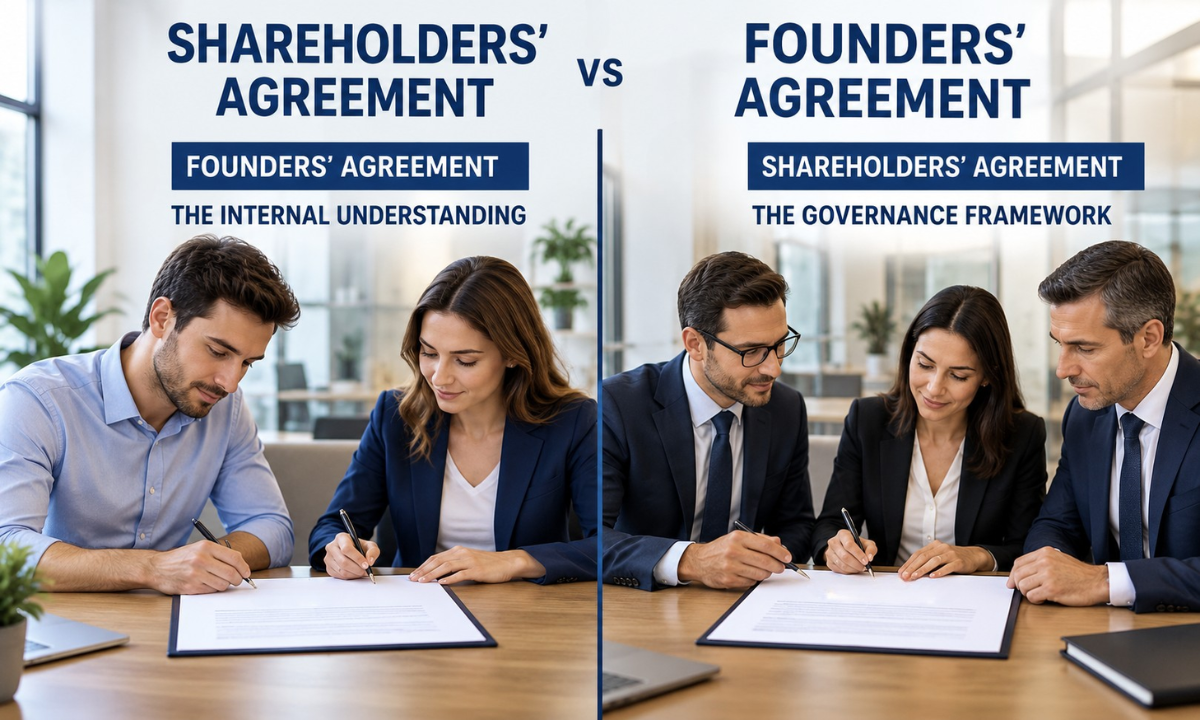
Both shareholder and founder agreements support business stability, but they address different relationships and legal concerns.
| Basis of comparison | Founders’ Agreement | Shareholders’ Agreement |
|---|---|---|
| Primary purpose | Establishes the founders’ working relationship | Regulates shareholder rights and obligations |
| Parties involved | Usually the founding team and, where appropriate, the company | The company and relevant shareholders, depending on the agreement |
| Main focus | Roles, contributions, equity allocation, and founder commitments | Voting, share transfers, investor protections, and exit rights |
| Ownership | Records the initial equity arrangement and related conditions | Governs rights attached to shareholding and changes in ownership |
| Equity vesting | Often establishes founder vesting arrangements | May address shareholding consequences and related transfer or exit provisions |
| Investor participation | May be created before external investment | Commonly negotiated or updated when investors join |
| Decision-making | Defines founder responsibilities and internal authority | Establishes shareholder approval rights and governance protections |
| Typical use | Business formation and early-stage planning | Multiple shareholders, fundraising, and later growth |
| Duration | May apply while founders remain involved, subject to its terms | Often continues while the relevant parties hold shares or as otherwise agreed |
The exact scope depends on the drafting, the parties who sign, and the company’s legal structure. Neither agreement should be treated as a substitute for the company’s constitutional documents or mandatory statutory requirements.
4. How Do Ownership Rights and Responsibilities Differ?
Ownership is a central concern in both agreements, but each document approaches it differently.
A Founders’ Agreement records how the founders intend to divide ownership and what obligations are linked to their contributions. It can also address what happens when a founder fails to meet agreed commitments or leaves the business.
A Shareholders’ Agreement focuses on the rights that arise from share ownership. These may include voting, access to information, dividend-related matters, share transfers, and protections against certain corporate decisions.
The agreements should be consistent with the company’s share records, applicable law, and constitutional documents. In India, the Companies Act, 2013, and the company’s Articles of Association are important considerations when structuring these rights.
For a broader understanding, see How Corporate Law Regulates Shareholder Rights.
5. Why Is Equity Vesting Important?

Equity vesting determines when a founder earns or retains the right to their allocated shares or equity benefits under an agreed arrangement. It can help protect a startup if a founder leaves before making the expected contribution.
For example, three founders may initially agree to equal ownership. If one founder leaves shortly after launch, the remaining founders may face difficulties if the departing founder retains a substantial stake despite no longer contributing to the business.
A carefully drafted Founders’ Agreement can establish a vesting schedule, a cliff period, and appropriate consequences for early departure. The actual mechanism must be structured around the company’s shareholding arrangements and applicable law.
A Shareholders’ Agreement may complement these provisions by addressing share transfers, buyback arrangements where legally permitted, and the rights of remaining shareholders.
Vesting provisions should clearly define:
- The vesting period and applicable milestones.
- The treatment of vested and unvested equity when a founder leaves.
- The process for voluntary departure or termination.
- Any applicable transfer, repurchase, or dispute-resolution mechanisms.
These terms are especially important when preparing a startup for future fundraising.
6. When Should a Startup Use Each Agreement?
The choice depends on the company’s stage, ownership structure, and business needs.
Use a Founders’ Agreement when:
- Two or more people are starting a business together.
- Founders need to define their initial equity split and responsibilities.
- The business requires clear intellectual property ownership.
- The founders want to agree on vesting and exit arrangements before launch.
Use a Shareholders’ Agreement when:
- External investors acquire shares in the company.
- Multiple shareholders need defined voting and information rights.
- The company requires restrictions on share transfers.
- Investors and founders need agreed procedures for major decisions and exits.
In many cases, a startup benefits from having both agreements. The Founders’ Agreement establishes the initial working arrangement, while the Shareholders’ Agreement governs the wider ownership relationship as the company develops.
When new investors enter, the existing agreements should be reviewed and updated where necessary to avoid conflicting obligations.
7. Can a Startup Have Both Agreements?
Yes. A startup can use both agreements because they serve complementary purposes.
Consider a startup founded by two entrepreneurs. They sign a Founders’ Agreement that defines their respective responsibilities, equity allocation, vesting conditions, and intellectual property obligations. After the company gains traction, a venture capital investor acquires a stake.
The parties may then negotiate a Shareholders’ Agreement covering voting rights, board representation, reserved matters, share transfers, and exit arrangements.
The original Founders’ Agreement may continue to govern founder-specific obligations, while the Shareholders’ Agreement establishes rights and protections for the wider shareholder group.
However, overlapping clauses should be reviewed carefully. The agreements should identify which provisions apply to each party and how conflicting terms will be handled. The company’s Articles of Association must also be considered, particularly where shareholder rights need to be reflected in the company’s constitutional framework under Indian law.
Professional contract drafting and review can help align these documents with the company’s structure and commercial objectives.
Conclusion
A Founders’ Agreement and a Shareholders’ Agreement serve different but connected purposes. The former defines the relationship between founders, including their roles, equity allocation, vesting, and commitments. The latter governs shareholder rights, voting, investor protections, share transfers, and exit arrangements.
For startups in India, using the appropriate agreements at the right stage can reduce ownership disputes and strengthen startup governance. The documents should reflect the company’s actual arrangements, remain consistent with one another, and comply with applicable corporate law.
The objective is not simply to document ownership, but to establish clear rules for decision-making, accountability, and future growth.