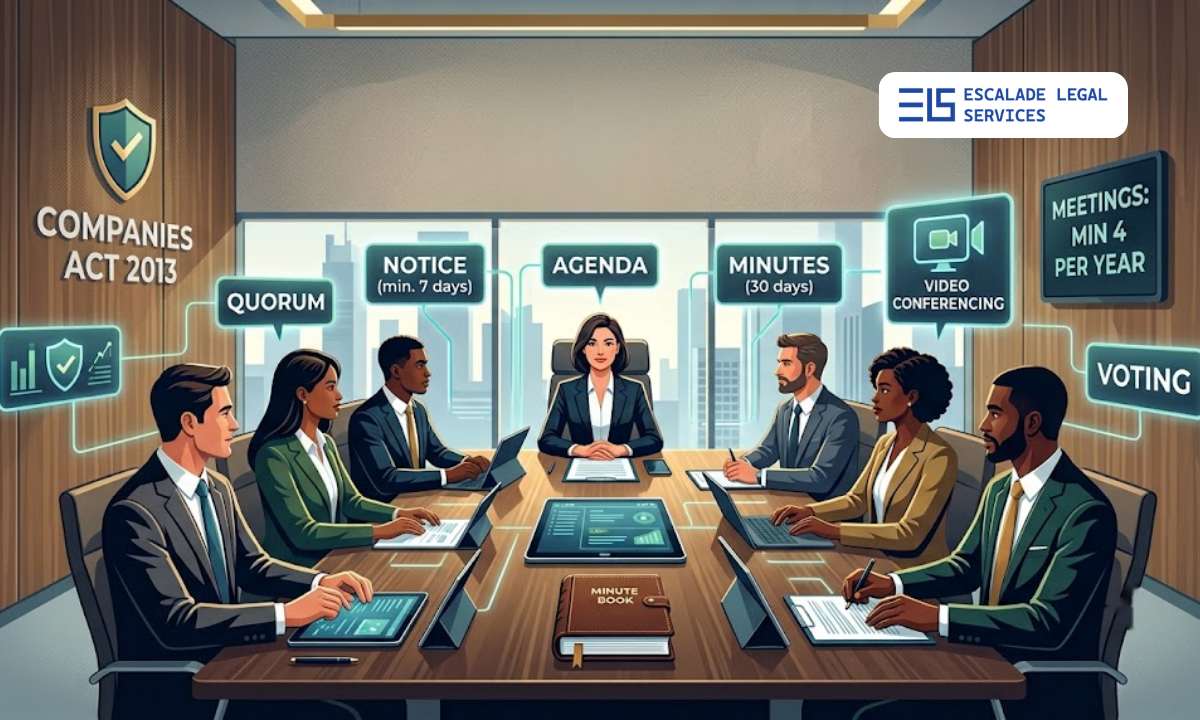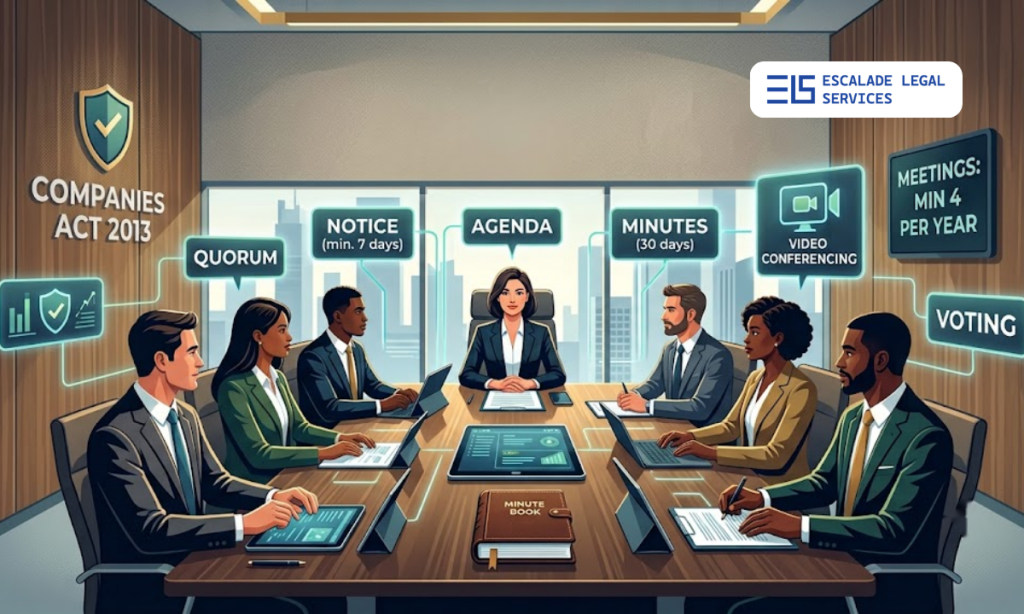
Board meetings are an essential part of corporate decision-making in India. Directors use these meetings to review business performance, approve important transactions, monitor compliance, consider financial matters and take decisions that require formal Board authority.
Under the Companies Act, 2013, companies are required to follow specific rules concerning the frequency, notice, quorum, participation, agenda and recording of Board meetings. These requirements are further supplemented by the Secretarial Standard on Meetings of the Board of Directors, known as SS-1, issued by the Institute of Company Secretaries of India.
For companies seeking corporate lawyers in Bangalore , professional legal support can help ensure that Board meetings are properly planned, documented and conducted in accordance with applicable corporate law requirements.
What Is a Board Meeting?
A Board meeting is a formally convened meeting of the directors of a company to discuss and decide matters relating to the company’s management, operations, finances, compliance and strategic affairs.
The Board exercises important powers through properly authorised decisions. Depending on the matter, these decisions may be recorded through Board resolutions, approvals, recommendations or directions to the company’s management.
Board meetings are therefore more than routine discussions. They create an official corporate record of how directors considered and approved important matters.
The Companies Act, 2013 establishes statutory requirements for Board meetings, while SS-1 provides detailed standards for the manner in which Board meetings should be convened and documented. ICSI states that SS-1 applies to Board and Board Committee meetings and is intended to standardise meeting practices and strengthen governance.
Which Law Governs Board Meetings in India?
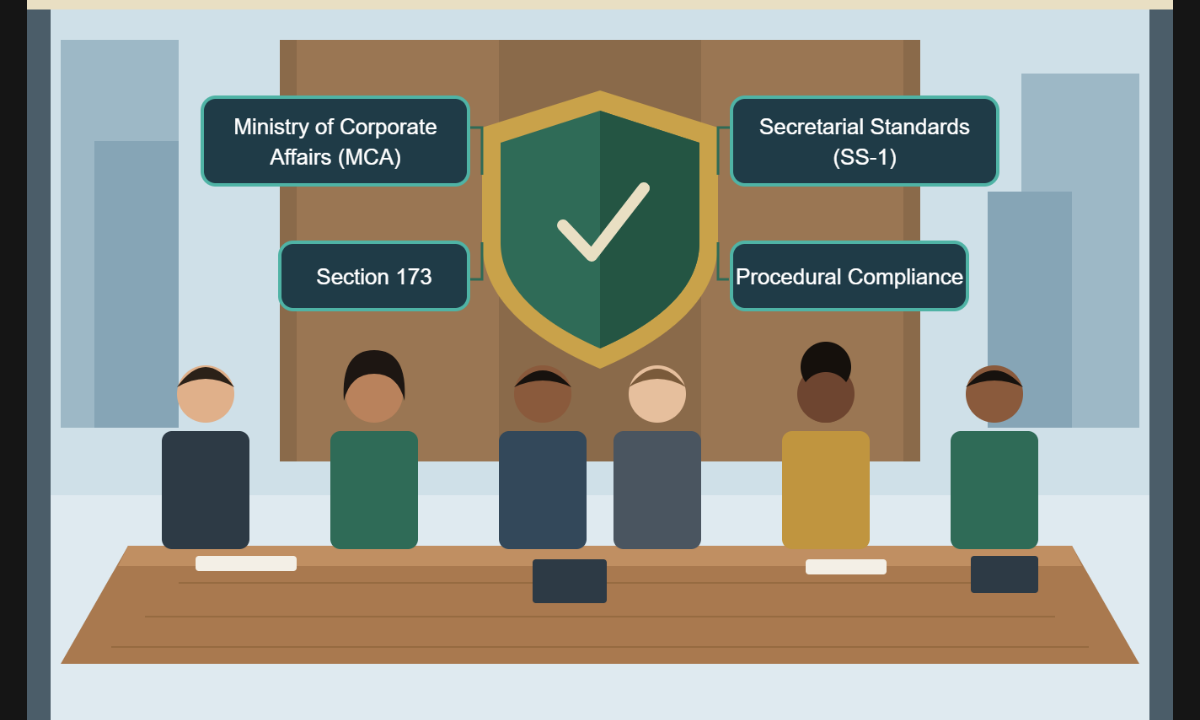
The primary legal framework is the Companies Act, 2013.
Section 173 deals with meetings of the Board, including the first Board meeting, minimum annual frequency, the interval between meetings, participation through electronic means and notice requirements.
Section 174 deals with quorum for Board meetings.
Section 118 contains provisions relating to minutes and also recognises Secretarial Standards approved by the Central Government.
In addition, companies should consider:
- Companies Act, 2013
- Applicable rules made under the Act
- Secretarial Standard SS-1
- SEBI regulations for applicable listed entities
- The company’s Articles of Association
- Sector-specific regulatory requirements
The exact compliance requirements can vary depending on the type of company and the transaction being considered.
How Many Board Meetings Are Required in a Year?
For most companies, Section 173 requires the first Board meeting to be held within 30 days of incorporation.
After that, the company must generally hold a minimum of four Board meetings every year, with not more than 120 days between two consecutive meetings.
This means companies should not simply count four meetings at the end of the financial year.
The timing between consecutive meetings is also important.
Example
Suppose a company conducts Board meetings in:
- January
- April
- August
- November
The company must check the gap between each consecutive meeting and ensure that it does not exceed the statutory limit applicable to it.
Maintaining a compliance calendar can help directors and company secretaries track meeting dates in advance.
First Board Meeting After Incorporation
The first Board meeting has a specific statutory timeline.
Under Section 173, the first meeting of the Board should generally be held within 30 days from the date of incorporation.
The first meeting may deal with matters such as:
- Taking note of the Certificate of Incorporation
- Noting the company’s constitutional documents
- Appointment-related matters
- Disclosure of directors’ interests
- Opening of bank accounts
- Authorisation of statutory registrations
- Appointment of professionals where required
- Approval of initial business arrangements
- Other incorporation-related matters
Companies should prepare the agenda and supporting documents before the meeting so that the required matters can be properly considered and recorded.
Board Meeting Frequency for Small Companies, OPCs and Dormant Companies
Certain categories of companies receive specific relaxation under Section 173.
A One Person Company, small company and dormant company are generally deemed to have complied with the Board meeting requirement if at least one meeting is conducted in each half of the calendar year and the gap between the two meetings is not less than 90 days. Section 173 also contains a specific provision for an OPC having only one director.
Companies should first confirm whether they actually qualify for the relevant category before relying on the relaxed meeting requirement.
The company’s current status should be reviewed whenever there is a change in its capital, turnover, ownership or other relevant circumstances.
Notice of Board Meeting
Notice is an important part of Board meeting compliance.
Section 173 generally requires at least seven days’ notice in writing to every director at the address registered with the company. Notice may be sent through hand delivery, post or electronic means.
The notice should provide directors with sufficient information about the meeting so they can prepare for the matters proposed to be discussed.
A proper notice generally includes:
- Date of the meeting
- Day of the meeting
- Time
- Venue
- Mode of participation
- Agenda
- Notes on agenda items
- Relevant supporting documents
The company’s Articles and SS-1 should also be considered when preparing the notice.
Can a Board Meeting Be Called at Shorter Notice?
Yes, the Companies Act permits a Board meeting to be called at shorter notice for urgent business, subject to the statutory conditions.
Section 173 provides that a meeting may be called at shorter notice to transact urgent business, with specific requirements concerning the presence or subsequent ratification involving an independent director where applicable.
The fact that a meeting is being held at shorter notice should also be properly reflected in the meeting documentation.
Companies should not treat shorter notice as a substitute for normal meeting planning. It should be used only where the circumstances and applicable law permit it.
What Is the Quorum for a Board Meeting?
Quorum refers to the minimum number of directors required for a valid Board meeting.
Under Section 174, the quorum is generally:
One-third of the total strength of the Board or two directors, whichever is higher.
Participation through video conferencing or other permitted audio-visual means can also count for quorum.
Example
If a company has six directors:
One-third of six = two.
Therefore, the minimum quorum would generally be two directors, subject to the applicable provisions and Articles.
If a fraction results from calculating one-third, the applicable Secretarial Standard provides for rounding up to the next whole number.
Quorum Where Directors Are Interested
Special rules apply where interested directors form a significant portion of the Board.
Section 174 provides that where the number of interested directors is equal to or exceeds two-thirds of the total strength of the Board, the quorum for the relevant situation is determined with reference to the non-interested directors, subject to the statutory requirement that at least two such directors are present.
This becomes particularly relevant when the Board is considering related party transactions or matters involving directors’ interests.
Companies should therefore identify conflicts of interest before the meeting rather than waiting until the discussion begins.
Participation Through Video Conferencing
Modern companies frequently conduct Board meetings through electronic means.
Section 173 recognises participation through video conferencing or other audio-visual means capable of recording and recognising the participation of directors and recording and storing the proceedings.
However, companies should check whether any particular matter is subject to restrictions on electronic participation under the applicable rules.
The company should also maintain reliable records of participation, including the relevant date, time and mode of participation.
What Should Be Included in a Board Meeting Agenda?
A well-prepared agenda helps directors understand the matters requiring consideration.
Depending on the company, the agenda may cover:
Financial Matters
- Financial performance
- Budgets
- Borrowings
- Investments
- Banking arrangements
- Major expenditure
Corporate Matters
- Appointment or resignation of directors
- Changes in shareholding
- Share capital matters
- Corporate restructuring
- Subsidiary-related decisions
Compliance Matters
- Statutory filings
- Regulatory notices
- Compliance reports
- Audit matters
- Secretarial compliance
Commercial Matters
- Major contracts
- Business expansion
- Strategic partnerships
- Acquisitions
- New business arrangements
Governance Matters
- Related party transactions
- Conflict disclosures
- Committee matters
- Risk management
- Internal controls
The agenda should be sufficiently detailed for directors to understand the nature of the matter before the meeting.
Board Resolutions and Matters Requiring Board Approval
Certain corporate actions require formal approval by the Board.
Examples may include:
- Issuing securities
- Borrowing money
- Investing company funds
- Granting loans or guarantees
- Approving financial statements
- Appointment of key managerial personnel
- Entering into specified related party transactions
- Approving corporate restructuring matters
- Opening or changing bank mandates
- Authorising legal representatives
The exact approval requirement depends on the nature of the transaction and the relevant provision of the Companies Act.
The resolution should clearly record what has been approved and the authority granted to the relevant officers.
Passing Resolutions by Circulation
Not every Board decision necessarily needs to be taken at a physical or electronic Board meeting.
The Companies Act and SS-1 provide a mechanism for certain resolutions to be passed by circulation.
Under SS-1, directors can communicate their assent or dissent through permitted methods, and the resolution is subject to the prescribed approval requirements. If the required number of directors request that the matter be decided at a meeting, it should be considered accordingly.
A resolution passed by circulation should also be noted at a subsequent Board meeting and recorded appropriately.
Companies should therefore distinguish between:
- Matters that can be handled through circulation
- Matters that should be discussed at a Board meeting
- Matters requiring specific statutory approval
Disclosure of Interest by Directors
Directors have obligations concerning disclosure of their interests in companies, firms or other entities.
Where a director has an interest in a matter placed before the Board, the company should follow the applicable provisions regarding disclosure and participation.
SS-1 also contains requirements concerning interested directors and their participation in relevant Board discussions.
Proper disclosure is important because decisions involving undisclosed interests can create governance and compliance concerns.
Recording Minutes of Board Meetings
Minutes are an important corporate record because they document what happened during the meeting.
Minutes should accurately reflect:
- Date of the meeting
- Time of commencement
- Time of conclusion
- Names of directors present
- Attendance through electronic mode where applicable
- Presence of invitees
- Quorum
- Matters discussed
- Decisions taken
- Resolutions passed
- Dissent or abstention where applicable
ICSI’s current SS-1 material sets out procedures for preparation, circulation and finalisation of Board meeting minutes. The revised framework provides timelines for circulating draft minutes, receiving comments and entering the final minutes in the Minutes Book.
Minutes should therefore not be treated as a simple formality.
What Happens If There Is No Quorum?
A Board meeting cannot properly transact business where the required quorum is absent.
SS-1 provides that where a Board meeting cannot be held because of lack of quorum, it generally stands adjourned to the same day in the next week at the same time and place, unless the Articles provide otherwise. If the adjourned meeting again lacks quorum, the meeting stands cancelled.
Companies should monitor director availability before fixing important meetings to avoid unnecessary adjournments.
Board Meeting Compliance for Listed Companies
Listed companies may have additional governance requirements beyond the basic provisions of the Companies Act.
They may need to consider:
- SEBI regulations
- Board committee requirements
- Independent director requirements
- Disclosure obligations
- Stock exchange requirements
- Audit committee matters
- Related party transaction requirements
The exact requirements depend on the company’s listing status and applicable SEBI framework.
For listed entities, Board meeting planning should therefore be coordinated with securities law and disclosure calendars.
Documents Required for a Board Meeting
A properly organised Board meeting may involve several documents.
These can include:
- Notice of Board meeting
- Agenda
- Notes on agenda
- Supporting financial documents
- Draft resolutions
- Declarations of interest
- Previous meeting minutes
- Committee reports
- Compliance reports
- Agreements under consideration
- Financial statements
- Draft filings where applicable
The documents required will depend on the business being considered.
For example, a Board meeting approving a major commercial agreement may require a detailed contract and supporting transaction documents, while a meeting dealing with annual financial matters may require financial statements and audit-related materials.
Businesses that regularly prepare Board papers can also benefit from professional contract drafting review services when significant agreements are placed before directors for approval.
Board Meetings and Corporate Compliance
Board meetings form an important part of the company’s broader compliance system.
A company may have completed incorporation correctly but still face compliance problems if it fails to maintain proper Board meeting records and approvals.
Ongoing compliance can include:
- Maintaining statutory registers
- Recording Board decisions
- Monitoring filing deadlines
- Preparing resolutions
- Updating director records
- Maintaining minutes
- Tracking event-based compliance
- Reviewing related party matters
Companies may therefore require company formation compliance services not only during incorporation but also as part of their continuing corporate compliance framework.
Common Board Meeting Compliance Mistakes
Several avoidable mistakes can create corporate compliance issues.
Missing the 120-Day Gap
Companies sometimes schedule four meetings without checking the maximum interval between consecutive meetings.
Sending Notice Late
The statutory notice period should be monitored carefully unless a valid shorter-notice procedure applies.
Inadequate Agenda Papers
Directors should receive adequate information to consider the matters placed before them.
Ignoring Quorum
A meeting should not proceed with substantive business without the required quorum.
Poor Minute Documentation
Minutes should accurately record the proceedings and decisions rather than merely listing resolutions.
Failing to Record Conflicts
Directors’ interests should be properly disclosed and handled in accordance with applicable law.
Treating Board Approvals as Informal
Important corporate decisions should be properly authorised and documented.
Role of Corporate Lawyers in Board Meeting Compliance
Board meeting compliance involves both legal requirements and practical governance procedures.
Experienced corporate lawyers in Bangalore can assist companies with:
- Preparing Board meeting compliance calendars
- Reviewing meeting notices
- Preparing agendas and resolutions
- Advising on quorum requirements
- Reviewing director interest disclosures
- Preparing corporate approvals
- Reviewing Board minutes
- Advising on resolutions by circulation
- Supporting statutory compliance
- Reviewing governance procedures
- Advising on regulatory requirements
Escalade Legal’s corporate governance practice specifically includes Board meeting procedures, Board composition, director responsibilities, committee structuring, shareholder communication and statutory compliance.
Board Meetings and Corporate Governance
Board meetings are closely connected with corporate governance because they provide a formal mechanism through which directors exercise oversight.
Effective Board processes can help companies maintain:
- Accountability
- Transparent decision-making
- Proper delegation of authority
- Regulatory compliance
- Documented corporate decisions
- Better risk management
For businesses requiring structured corporate governance compliance, Board meeting procedures should be reviewed alongside the company’s wider governance framework.
Escalade Legal provides corporate governance and regulatory compliance support covering Board-level advisory, compliance audits, statutory filings, risk management and governance frameworks.
Board Meetings and Dispute Prevention
Proper Board documentation can also become important when a corporate disagreement arises.
A well-maintained record can help establish:
- What decision was considered
- Which directors participated
- Whether quorum existed
- What information was presented
- What resolution was passed
- Whether any director dissented
- What authority was given to management
Where a disagreement develops between directors, shareholders or other corporate stakeholders, businesses may require corporate dispute resolution assistance.
Good Board documentation does not eliminate every dispute, but it can provide an important record of the company’s decision-making process.
Board Meetings and Intellectual Property Decisions
Technology companies and IP-driven businesses may also need to place intellectual property matters before their Boards.
Examples can include:
- Approval of major IP licensing arrangements
- Technology transfer agreements
- Acquisition of intellectual property
- Brand licensing
- IP-related investments
- Commercialisation of proprietary technology
Where a Board decision involves significant intellectual property rights, an IP law firm in Bangalore may provide specialised advice alongside corporate counsel.
Businesses dealing with patents, trademarks, copyright or technology transactions may also consult IP lawyers in Bangalore where the matter requires specialist intellectual property analysis.
This is particularly relevant for technology, SaaS, manufacturing and innovation-focused companies.
Board Meeting Compliance Checklist
Before every Board meeting, companies can use the following checklist:
Before the Meeting
- Confirm the meeting date and time
- Check the required notice period
- Prepare the agenda
- Prepare notes on agenda items
- Circulate supporting documents
- Confirm director availability
- Check potential conflicts of interest
- Determine whether any matter requires special approval
During the Meeting
- Confirm quorum
- Record attendance
- Record electronic participation where applicable
- Identify interested directors
- Discuss agenda items
- Record decisions accurately
- Note dissent or abstention where applicable
- Pass required resolutions
After the Meeting
- Prepare draft minutes
- Circulate minutes within the applicable timeline
- Incorporate director comments
- Finalise and record the minutes
- Complete required filings
- Implement approved decisions
- Maintain supporting documents
Frequently Asked Questions
How many Board meetings are mandatory under the Companies Act, 2013?
Generally, a company must hold at least four Board meetings every year, with not more than 120 days between two consecutive meetings, subject to applicable exemptions and modifications.
When must the first Board meeting be held?
The first Board meeting must generally be held within 30 days from the date of incorporation.
What is the quorum for a Board meeting?
The general quorum is one-third of the total strength of the Board or two directors, whichever is higher, subject to the rules concerning interested directors and other applicable provisions.
Can Board meetings be conducted online?
Yes. The Companies Act permits participation through video conferencing or other permitted audio-visual means capable of recording and recognising participation and storing the proceedings, subject to applicable restrictions.
How much notice is required for a Board meeting?
The general statutory requirement is at least seven days’ written notice to every director, subject to the provisions allowing shorter notice for urgent business.
What is SS-1?
SS-1 is the Secretarial Standard on Meetings of the Board of Directors issued by ICSI. It provides detailed procedures for conducting and documenting Board meetings. ICSI currently lists the revised SS-1 as effective from 1 April 2024.
Can a Board resolution be passed without holding a meeting?
Certain resolutions can be passed by circulation subject to the Companies Act, SS-1 and the applicable requirements. Such resolutions must also be properly recorded and noted at a subsequent Board meeting where required.
What happens if a company does not comply with Board meeting requirements?
Non-compliance can result in statutory penalties and may create governance, filing and director-liability concerns depending on the nature of the default. The company should review the specific provision breached and the applicable consequences.
Why Choose Escalade Legal Services for Board Governance Support?
Board meeting compliance requires attention to statutory timelines, documentation, director responsibilities and the company’s wider governance framework.
Escalade Legal Services provides corporate legal and governance support to businesses at different stages of their operations. Its corporate practice covers company formation, regulatory compliance, corporate governance, commercial agreements, intellectual property and dispute resolution.
Businesses can seek support for:
- Board and Governance Advisory: Assistance with Board procedures, resolutions, director responsibilities and governance frameworks.
- Corporate Compliance Management: Support with statutory requirements, filings, records and event-based compliance.
- Commercial Documentation: Review of contracts and other documents placed before the Board.
- Regulatory Advisory: Guidance on Companies Act, SEBI, FEMA and other applicable requirements.
- Corporate Dispute Support: Assistance with disagreements involving directors, shareholders and corporate decisions.
For companies that want to establish consistent Board processes, professional legal guidance can help align Boardroom decision-making with statutory and governance requirements.
Conclusion
Board meetings are a fundamental part of corporate governance under the Companies Act, 2013. They provide directors with a formal platform to review business matters, exercise oversight and approve important corporate decisions.
Compliance begins with understanding the company’s meeting frequency, notice period and quorum requirements. It continues through proper agenda preparation, disclosure of interests, valid participation, accurate resolutions and timely preparation of minutes.
Companies should also consider SS-1 and any additional requirements applicable to their specific structure, industry or listing status. Maintaining a structured Board meeting calendar and reliable corporate records can make ongoing compliance more manageable.
For growing businesses, Board meetings should not be treated as paperwork completed only for statutory purposes. A properly organised Board process can create a clear record of corporate decisions and support stronger governance as the business expands.
Need Support With Board Meeting Compliance?
Escalade Legal Services assists businesses with corporate governance, Board-level legal requirements, statutory compliance and commercial decision-making. Our team can help companies structure their Board meeting processes, review resolutions and documentation, identify applicable legal requirements and address compliance issues before they become larger corporate concerns.
Whether your company needs assistance with routine Board meetings, urgent resolutions, director-related matters, regulatory approvals or ongoing governance compliance, obtaining timely legal guidance can help ensure that important corporate decisions are properly authorised and documented.
Headquarters: Escalade Legal Services, Chambers 401, DBS House Business Centre, No. 26, Cunningham Road, Bengaluru, Karnataka 560052
New Delhi Office: World Trade Towers, Barakhamba Lane, Connaught Place, New Delhi 110001
Official Website: escaladelegal.com
Direct Contact: +91 96110 57021 / escalade@escaladelegal.com
A disciplined Board meeting process gives companies a reliable foundation for compliant decision-making, stronger governance and responsible business growth.