
Have you ever wondered how companies restructure quickly without going through long court battles and tribunal hearings? A Fast Track Merger offers a simplified and time-bound route for eligible companies to merge without approaching the NCLT, making corporate restructuring faster and more efficient.
For many businesses, especially startups and group entities, understanding what a fast-track merger is can help save months of delay and high legal costs. Today, with the introduction of Fast Track Merger 2.0 under MCA 2.0 reforms, the scope has expanded even further, and that changes how businesses plan mergers in India.
As a corporate law firm in Bangalore, India, we often see companies confused about eligibility, approvals, and timelines, so let’s break it down step by step.
And if you’re considering restructuring or consolidating your group companies, this guide will help you understand whether the fast-track route is right for you.
Disclaimer:
The information provided in this blog is for general informational purposes only and does not constitute legal advice. The applicability of Fast Track Merger provisions may vary depending on the specific facts, eligibility criteria, and regulatory updates. We recommend consulting a qualified legal professional before initiating any merger or restructuring process to ensure full compliance with applicable laws.
Key Points At A Glance
- Fast Track Merger is governed by Section 233 of the Companies Act, 2013
- It bypasses NCLT approval and instead requires Regional Director approval
- Requires 90% shareholder and creditor approval (by value)
- Fast Track Merger 2.0 expands eligibility to more companies
- Cross-border reverse mergers are now possible
- The timeline is significantly shorter than traditional mergers
- Ideal for startups, small companies, and holding–WOS mergers
What Is Fast Track Merger?

A Fast Track Merger is a simplified corporate restructuring mechanism introduced under Section 233 of the Companies Act, 2013. It allows certain classes of companies to merge without approaching the National Company Law Tribunal (NCLT).
Instead of tribunal approval, the process is handled by the Regional Director (RD), along with oversight from the Registrar of Companies (ROC) and the Official Liquidator. This makes the process quicker and less complex.
Key Features:
| Feature | Fast Track Merger |
|---|---|
| Governing Law | Section 233, Companies Act |
| Tribunal Involvement | Not required |
| Approving Authority | Regional Director |
| Shareholder Approval | 90% (by value) |
| Creditor Approval | 90% (by value) |
| Typical Timeline | Around 60 days |
This structure makes it ideal for internal group reorganizations.
Who Can Use Fast Track Merger?
Under the original Fast-Track Merger Rules Companies Act, eligibility was limited. The framework was designed primarily for companies where ownership was closely held, and the risk to public interest was relatively low.
This meant that only specific categories of companies could take advantage of the simplified Fast Track Merger route. The objective was to make internal restructurings faster while ensuring regulatory oversight remained intact.
Earlier Eligible Companies:
- Small companies
- Startup companies
- Holding company and wholly owned subsidiary (WOS)
- A certain prescribed class of companies
The idea was to simplify mergers for entities where public interest concerns were minimal.
What Is Fast Track Merger 2.0?

The major reform came with Fast Track Merger 2.0 under MCA 2.0 amendments, effective September 2025. These changes significantly widened the scope and made the fast-track mechanism more practical for modern corporate restructuring needs.
The government recognized that many growing businesses, especially startups and group entities, required a quicker exit or consolidation route without lengthy tribunal intervention. As a result, eligibility criteria were expanded to make the process more inclusive and aligned with global restructuring trends.
Now, the fast-track route is not restricted only to small entities. It includes:
- Small companies
- Startups
- Holding and wholly owned subsidiaries
- Certain unlisted companies
- Foreign holding companies merging with Indian WOS
This reform supports India’s push for ease of doing business.
How Fast-Track Mergers 2.0 Work – Step-by-Step Process
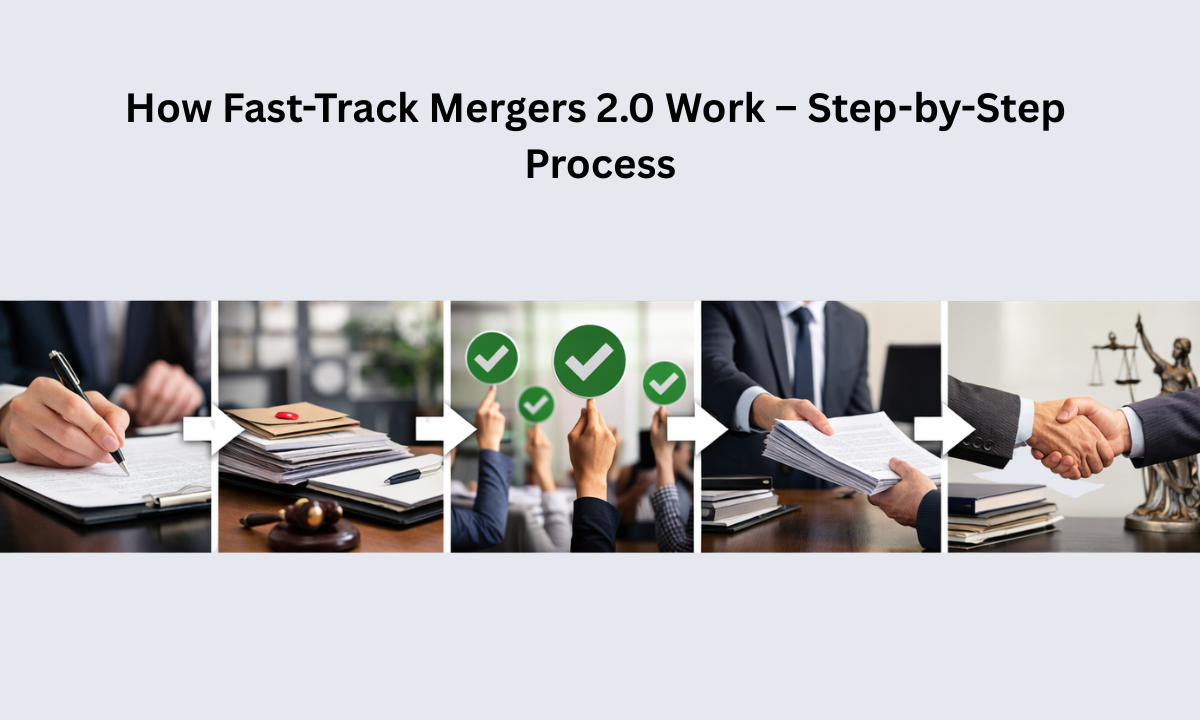
Let us understand the process in simple terms. Even though the Fast Track Merger route avoids the NCLT, it still follows a structured legal procedure under Section 233 of the Companies Act. The entire process is designed to be time-bound, transparent, and compliance-driven.
Proper board approvals must be obtained before initiating the merger process. Each company involved must pass a board resolution approving the draft scheme before circulating it to shareholders and creditors.
Step 1: Draft the Scheme of Merger
We prepare a detailed scheme outlining assets, liabilities, the share exchange ratio, the appointed date, and the effective date. This document forms the backbone of the merger and must clearly explain how stakeholders’ interests are protected.
Step 2: Issue Notice
Notices are sent to:
- Registrar of Companies (ROC)
- Official Liquidator
- Shareholders and creditors
These authorities are allowed to review the scheme and raise objections, if any, within the prescribed timeline. Creditors are specifically informed so their financial interests are safeguarded.
Step 3: Obtain Approvals
At least 90% of shareholders and creditors (by value) must approve the scheme. This high threshold ensures that the merger has strong stakeholder backing and reduces the likelihood of disputes later.
Step 4: Filing with the Regional Director
The approved scheme, along with required declarations, auditor certificates, and compliance confirmations, is filed with the Regional Director for review. Accuracy at this stage is critical to avoid queries or delays.
Step 5: Review and Objections
The Regional Director examines the scheme and considers any objections raised by the ROC or Official Liquidator. If concerns arise, clarifications or modifications may be requested before granting approval.
Step 6: Final Approval and Effect
If there are no major objections, the RD approves the merger. Upon filing the confirmation order with the ROC, the merger becomes legally effective, and the transferor company stands dissolved without winding up, all without approaching the NCLT.
Traditional Merger vs Fast Track Merger

Before choosing the right restructuring route, it is important to understand how a traditional merger differs from a Fast Track Merger. While both processes aim to combine companies, the procedural requirements, timelines, and regulatory involvement vary significantly.
Traditional mergers involve tribunal supervision and multiple hearings, whereas the fast-track route is designed to simplify approvals for eligible companies. The comparison below highlights the key practical differences.
| Aspect | Traditional Merger | Fast Track Merger |
|---|---|---|
| Approval Authority | NCLT | Regional Director |
| Timeframe | 6–12 months | Around 60 days |
| Complexity | High | Moderate |
| Cost | Expensive | Cost-effective |
| Suitable For | Large/public companies | Startups & group entities |
This comparison shows why many businesses now prefer the fast-track route.
Cross-Border Reverse Mergers Under Fast Track 2.0
One of the biggest highlights of Fast Track Merger 2.0 is cross-border restructuring. The amendments recognise the growing trend of Indian startups incorporating overseas for funding convenience and later seeking to shift their base back to India.
Foreign holding companies can now merge with their Indian wholly owned subsidiaries under the fast-track route, subject to regulatory compliance. This facilitates “reverse flipping,” where startups originally incorporated abroad relocate their parent entity structure to India in a simplified and time-bound manner.
For startups looking to align with Indian regulatory frameworks, attract domestic investors, or benefit from Indian tax and policy incentives, this is a major strategic advantage. It also strengthens India’s position as a preferred jurisdiction for global corporate restructuring.
Benefits of Fast Track Merger
Let us look at the practical advantages. For many businesses, especially startups and closely held companies, time and cost savings play a major role in choosing the right merger route. The Fast Track Merger mechanism is designed to reduce procedural burden while maintaining regulatory oversight.
1. Faster Approvals
Since NCLT approval is not required, timelines are reduced significantly. The involvement of the Regional Director instead of a tribunal makes the process more streamlined and predictable.
2. Cost-Effective
Lower legal fees and procedural costs compared to tribunal-based mergers. Reduced hearings and fewer court appearances translate into substantial savings.
3. Simplified Documentation
Fewer hearings and reduced litigation risk. The documentation process is structured but less complex than traditional mergers, making compliance easier to manage.
4. Ideal for Internal Restructuring
Perfect for holding-subsidiary mergers and group consolidations. It allows businesses to realign their structure without disrupting operations for long periods.
For growing companies, speed and efficiency are critical, and the fast-track route supports both without compromising legal compliance.
Important Compliance Requirements
Even though it is simplified, compliance is strict. The Fast Track Merger route does not eliminate regulatory scrutiny; it only streamlines the approval mechanism.
Companies must ensure that all statutory filings, disclosures, and approvals are properly completed before approaching the Regional Director. Any procedural lapse or incomplete documentation can lead to objections, delays, or even transfer of the matter to the NCLT.
Key Conditions:
- 90% shareholder approval (by value)
- 90% creditor approval (by value)
- No public interest concerns
- Proper filing with ROC and RD
Any objection from authorities may shift the case to NCLT.
When Should You Consider a Fast Track Merger?
A Fast Track Merger is not suitable for every restructuring situation. It works best when the companies involved fall clearly within the eligibility criteria and when there is strong internal consensus among shareholders and creditors.
Before initiating the process, we should evaluate business objectives, tax implications, and regulatory conditions. Careful planning ensures that the merger qualifies under the fast-track framework and does not get redirected to the NCLT.
You should consider it when:
- Merging a wholly owned subsidiary
- Restructuring internal group companies
- Reverse flipping a foreign holding company
- Consolidating small entities
Early planning is essential.
A Mergers And Acquisitions Firm In India can help structure the transaction to meet eligibility requirements and avoid procedural delays.
Common Mistakes to Avoid
While the Fast Track Merger process is simplified, mistakes in compliance or documentation can still cause serious delays. Many companies assume the procedure is automatic and underestimate the importance of careful planning and drafting.
Even a small procedural lapse can result in objections from the Registrar of Companies or the Regional Director. Identifying potential risks early helps ensure smooth approval without escalation to the NCLT.
- Not checking eligibility under Fast-Track Merger Rules Companies Act
- Incomplete creditor disclosures
- Poor drafting of the scheme of merger
- Ignoring tax implications
Professional drafting reduces the risk of objections.
Final Thoughts
Corporate restructuring should not always mean lengthy tribunal procedures. With the introduction of Fast Track Merger 2.0 under MCA 2.0 reforms, businesses now have a practical and time-efficient alternative.
Working with a corporate law firm in Bangalore, India ensures that eligibility is correctly assessed, documentation is properly drafted, and approvals are secured without delays. At Escalade Legal Services, we assist companies in structuring mergers, ensuring compliance under the Fast-Track Merger Rules Companies Act, and guiding them through every stage of the process with clarity and precision.
FAQs
1. What is Fast Track Merger in simple terms?
A Fast Track Merger is a simplified merger mechanism available under Section 233 of the Companies Act, 2013. It allows eligible companies, such as small companies or holding wholly owned subsidiaries, to merge without approaching the NCLT. Instead, approval is granted by the Regional Director.
This makes the process faster, more cost-effective, and less complex compared to traditional tribunal-based mergers.
2. How long does Fast Track Merger 2.0 take?
Fast Track Merger 2.0 is designed to be completed within approximately 60 days, provided there are no objections from the Registrar of Companies or the Official Liquidator.
The actual timeline depends on proper documentation, timely shareholder and creditor approvals, and accurate filings. Delays usually occur due to incomplete disclosures or compliance gaps during the review stage.
3. Is shareholder approval mandatory?
Yes, shareholder approval is mandatory for a Fast Track Merger. At least 90% approval by value from shareholders and creditors is required before filing the scheme with the Regional Director. This high threshold ensures strong stakeholder consensus and protects minority interests. Without meeting this approval requirement, the merger cannot proceed under the fast-track route.
4. Can foreign companies use Fast Track Merger 2.0?
Yes, under the 2025 amendments, foreign holding companies can merge with their Indian wholly owned subsidiaries through the fast-track mechanism. This enables cross-border restructuring and reverse flipping, where companies relocate their holding structure back to India.
However, compliance with foreign exchange regulations and other applicable laws remains essential for such mergers.
Reference