In today’s borderless digital economy, businesses aiming to expand globally must register a trademark internationally to safeguard their brand identity and commercial value. As Indian companies increasingly tap into overseas markets, understanding global trademark protection has become a business necessity rather than a legal luxury.
This is where the Madrid Protocol plays a crucial role by simplifying international trademark filings, especially for businesses seeking international trademark registration in India. Read on till the end to discover how one smart system can protect your brand across multiple countries with ease.
Disclaimer:
The information provided in this blog is for general informational purposes only and does not constitute legal advice. Trademark laws and procedures may vary based on jurisdiction and individual circumstances. Readers are advised to consult a qualified legal professional before making any decisions related to international trademark registration.
Key Points at a Glance
- What the Madrid Protocol is and why it matters
- How trademark international registration works
- Step-by-step procedure for registration of trademark internationally
- Breakdown of trademark registration cost
- Role of WIPO Madrid monitor in tracking applications
- Practical tips for smooth IP registration
What Is the Madrid Protocol?

The Madrid Protocol is an international treaty that allows trademark owners to seek protection in multiple countries by filing a single application. Instead of registering your trademark separately in each country, the Madrid system centralizes the process. It is administered by the World Intellectual Property Organization (WIPO), ensuring uniformity and efficiency.
We often explain it as a one-stop solution for international trademark protection. With over 130 member countries, it covers most major global markets. For Indian businesses, it offers a streamlined path to global brand protection.
Why Is Trademark International Registration Important?
As brands expand beyond national borders, the risk of imitation and infringement increases significantly. Without proper protection, a business may lose exclusive rights to its trademark in foreign markets. This is why trademark international registration is essential for long-term growth.
International registration helps businesses:
- Secure exclusive brand rights globally
- Prevent misuse or duplication of trademarks
- Build credibility with international customers
- Strengthen brand valuation and investor confidence
How the Madrid Protocol Works
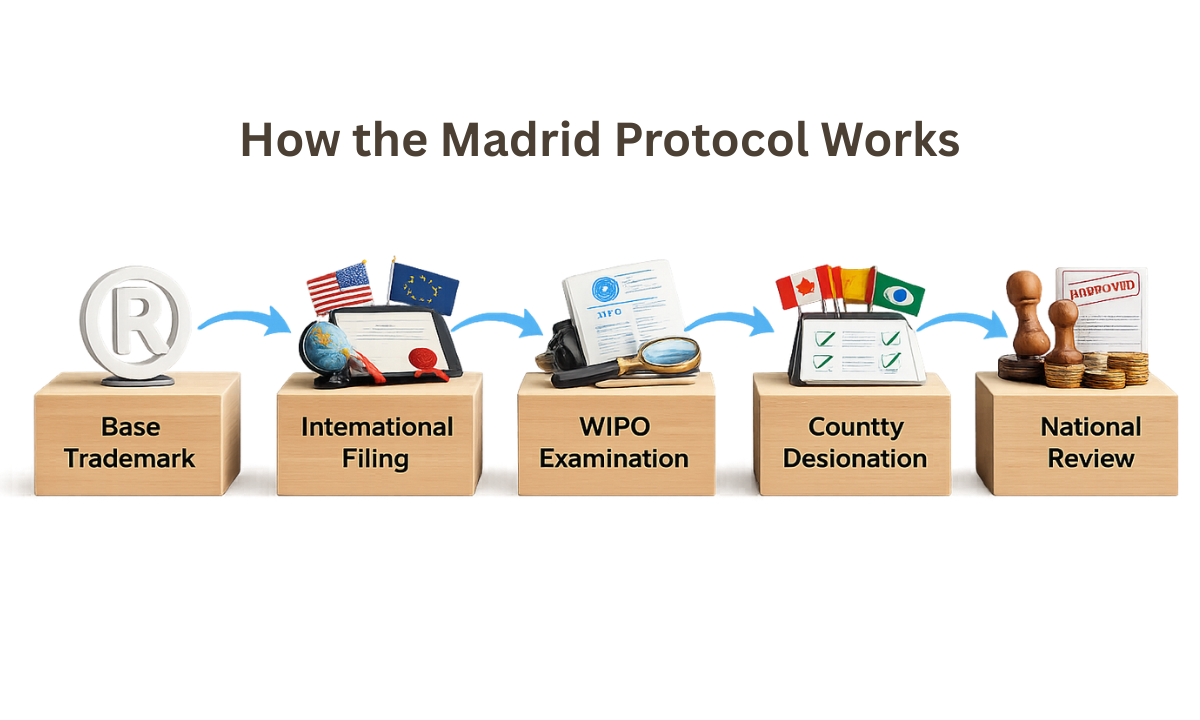
Under the Madrid system, you can register a trademark internationally using a base trademark application or registration from your home country. This base application acts as the foundation for international protection. Once filed, WIPO manages communication between the applicant and the selected countries.
| Stage | Explanation |
|---|---|
| Base Trademark | National application or registration |
| International Filing | Submitted through the Indian Trademark Office |
| WIPO Examination | Checks formal requirements |
| Country Designation | Applicant selects target countries |
| National Review | Each country applies its own laws |
Who Can Apply Under the Madrid Protocol?
To file under the Madrid Protocol, the applicant must have a valid connection with a member country. This can be through nationality, domicile, or business establishment. Indian applicants qualify through their registration with the Indian Trademark Office.
We always recommend ensuring the base trademark is strong and objection-free. Any cancellation or refusal of the base mark within five years can affect the international registration.
Procedure For Registration Of Trademark Internationally
The Procedure For Registration Of Trademark under the Madrid Protocol follows a structured approach. While the system simplifies filings, attention to detail remains critical.
Key steps involved:
- File or hold a valid Indian trademark application
- Submit an international application through the Indian Trademark Registry
- Pay applicable WIPO and country-specific fees
- Track progress via WIPO Madrid Monitor
- Respond to objections, if any, from designated countries
Understanding WIPO Madrid Monitor
The WIPO Madrid Monitor is an online tracking tool that allows applicants to monitor the status of their international trademark applications. It provides updates on approvals, refusals, renewals, and changes in ownership.
We strongly suggest using this tool to stay updated throughout the registration lifecycle. It ensures transparency and helps avoid missed deadlines.
Trademark Registration Cost Explained
The Trademark Registration Cost under the Madrid Protocol depends on multiple variables. These include the number of countries selected, the type of trademark, and additional legal support if required.
| Cost Component | Description |
|---|---|
| Basic WIPO Fee | Mandatory fixed fee |
| Designation Fees | Depends on the chosen countries |
| Legal Assistance | Safe and beneficial |
| Renewal Charges | Payable every 10 years |
Although the upfront cost may seem higher, it is far more economical than filing multiple national applications separately.
Trademark Certificate and Validity
Once approved, WIPO issues an international Trademark Certificate. This certificate confirms trademark protection in all designated countries where no refusal has been raised. The registration remains valid for 10 years and can be renewed indefinitely.
We recommend maintaining both digital and physical copies securely. This document is often required for licensing, franchising, and enforcement purposes.
Benefits of International Trademark Registration for Indian Businesses
For Indian startups and established businesses, international registration strengthens global market entry. It also enhances brand trust and reduces the risk of costly disputes abroad. The Madrid Protocol makes IP Registration far more manageable for Indian applicants.
By centralizing filings, renewals, and modifications, businesses can focus more on growth rather than paperwork. This is especially valuable for exporters and digital-first brands.
Practical Tips for Successful International Registration
Here are some practical tips we often share:
- Choose countries based on business expansion plans
- Conduct trademark searches before filing
- Monitor timelines using WIPO tools
- Plan budgets for renewals and future expansions
- Seek professional guidance for complex jurisdictions
These small steps can prevent delays and unnecessary costs.
Common Pitfalls to Avoid
Many businesses rush into international registration without long-term planning. This can lead to refusals or wasted investment. We always advise aligning trademark strategy with overall business goals.
Avoid selecting too many countries without a clear intent. Each designated country may still apply its own trademark laws.
Final Thoughts
Global brand protection is no longer optional for ambitious businesses. The Madrid Protocol offers a structured, cost-effective way to expand trademark protection worldwide. For companies exploring international trademark registration in India, early planning ensures smoother approvals and stronger brand security.
With the right guidance, international trademark protection becomes far less complex. At Escalade Legal Services, we focus on simplifying trademark strategies so businesses can expand globally with clarity and confidence.
FAQs
1. Is the Madrid Protocol a global trademark?
No, it is a filing system, not a single global trademark. Each country independently examines the application.
2. How long does the process take?
On average, it takes 12 to 18 months, depending on objections and country-specific reviews.
3. Can changes be made after trademark registration?
Yes, certain changes, like ownership updates, can be recorded centrally through WIPO.
4. Can a single international trademark application be refused by some countries and accepted by others?
Yes, this is possible under the Madrid Protocol. Each designated country independently examines the trademark according to its national laws. A refusal in one country does not affect approval or protection in other selected countries.
5. Is international trademark registration mandatory for exporting goods or services?
International trademark registration is not legally mandatory for exporting. However, it is strongly recommended to prevent brand misuse, counterfeiting, and legal disputes in foreign markets, especially when operating through distributors, e-commerce platforms, or franchise models.